
Biryani
Lift the lid on a pot of biryani and the whole house knows about it: saffron, fried onions, warm spice, steam rolling off long grains of rice layered over…
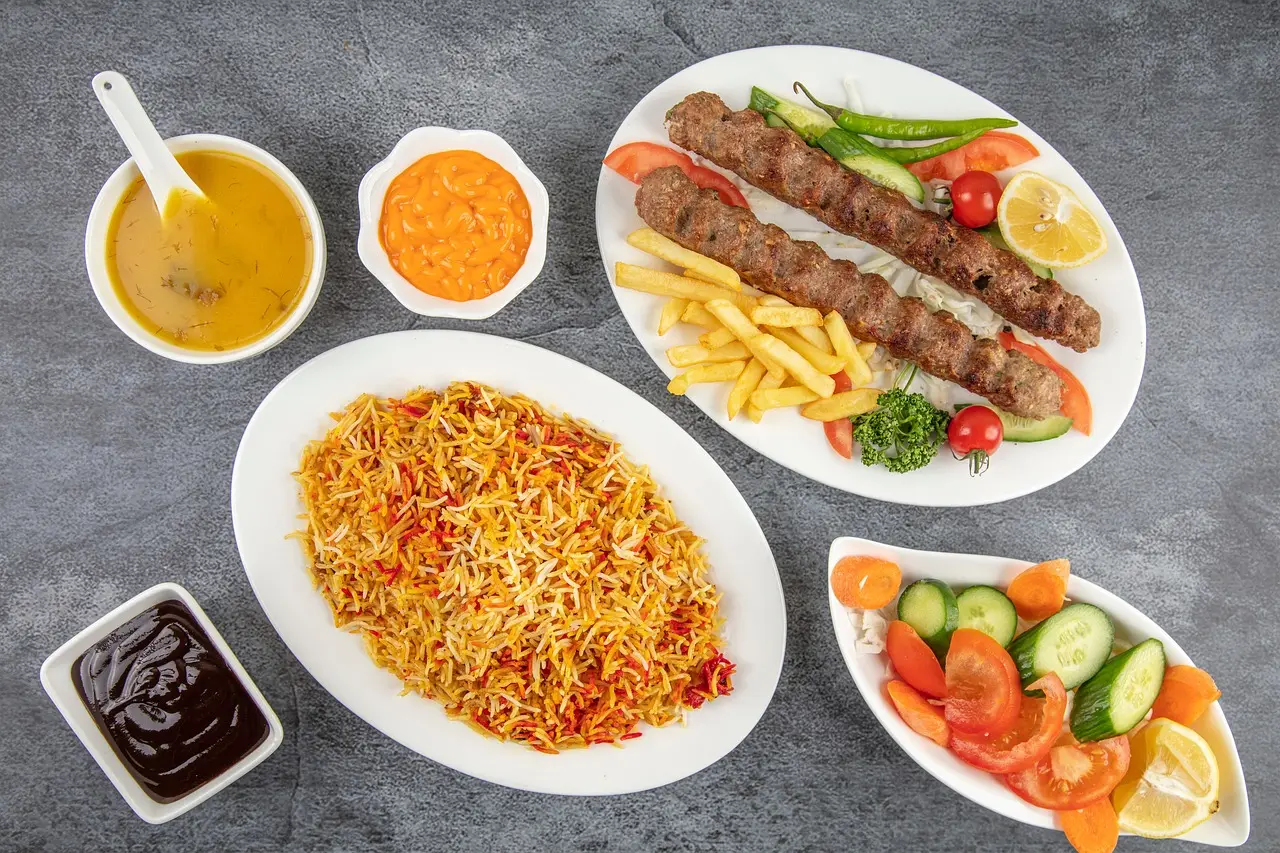
Lift the lid on a pot of biryani and the whole house knows about it: saffron, fried onions, warm spice, steam rolling off long grains of rice layered over meat that has been slowly sealing in its own juices. It is South Asia's great celebration dish, the one at the centre of weddings and Eid tables, and in India the dish people order online more than any other 1. Everyone agrees it's magnificent. Almost nobody agrees on where it came from.
Background
The name gives the first clue. It comes from Persian biryan, "fried" or "roasted", and the phrase birinj biryan, "fried rice" 1. One Dhaka writer reads it as "fried before cooking", which matches what the cook does: rice and meat get a turn in ghee before they ever meet the steam 3.
There are two big schools. In pakki biryani, the meat cooks first and then gets layered with part-cooked rice. In kacchi biryani, raw marinated meat goes into the pot under the rice, the lid is sealed (often with dough), and the whole thing cooks low and slow. That slow sealed cooking is called dum 13. Kacchi is the braver method: you can't peek, so you trust your timing and your nose.
And biryani versus pulao? Ask three experts and get three answers. Cookery writer Pratibha Karan says biryani is layered, with meat between two layers of rice, and pulao isn't. Delhi historian Sohail Hashmi says pulao is plainer, while biryani carries more gravy and cooks longer 1. Food historian K. T. Achaya pointed out that the Ain-i-Akbari, the record of Emperor Akbar's court, didn't bother separating the two at all 2. Argue about it at dinner. Everyone does.
History
Here's where it gets fun, because the origin stories are better than the evidence.
The legends. One story credits the conqueror Timur with bringing biryani to India. Another says Mumtaz Mahal, the empress of Taj Mahal fame, ordered a cook to make something nourishing for thin soldiers 4. Historians aren't buying either. There's no record of biryani in Timur's Central Asia at the time, and LiveHistoryIndia calls both attributions incorrect 12.
The Mughal kitchen. Historian Lizzie Collingham argues modern biryani took shape in the Mughal royal kitchens under Akbar (1556–1605), where delicate Persian pilau met the bolder, spicier rice dishes of Hindustan 1.
The earlier road. Historian Salma Hussein and others think it arrived from Persia before the Mughals, probably reaching the Deccan in the south with soldiers, statesmen and pilgrims 1. And Tamil cooks had a rice, meat and spice dish called oon soru long before any of this; one writer puts it at nearly 2,000 years old 4.
The local verdict. Historian Mohsina Mukadam sums up the mood well: the idea may have travelled, but biryani, with its spices, is in Mukadam's view a fully Indian innovation 2.
Then it spread and changed with every move. When the Mughals made Dhaka the capital of Bengal in 1610, cooks brought Awadhi-style kacchi biryani with them, and Dhaka's version kept that old technique long after other cities moved on 3. Lucknow's cooks leaned Persian, Moradabad's took on Afghan touches, Malabar's carry the mark of Arab traders, and Hyderabad's picked up the heat of Andhra cooking 2.
The famous potato. In 1856 the British deposed Wajid Ali Shah, the last Nawab of Awadh, and he moved his court to Calcutta, now Kolkata. The usual story says money ran short, so the cooks stretched the meat with potatoes, and Kolkata biryani has carried a golden potato ever since 12. Potatoes had reached Bengal in the late 1700s, and in Dhaka they simply joined a pot that was already old 3. Whatever the real reason, the potato stayed, and it is now the signature of the city's biryani 2.
Customs, rules and rituals
Biryani is party food at heart. It anchors countless Indian holidays and weddings, and in Old Dhaka, kacchi mutton biryani is the wedding dish 1. One Dhaka cook, Fakruddin Munshi, learned dum cooking from a Nawab's chef and became so famous that weddings he catered passed into family legend 3.
It also marks the religious year. At Bakr Eid (Eid al-Adha), many Muslim families cook biryani with mutton from goats sacrificed in memory of the prophet Abraham 1.
Regional pride runs high. Kolkata's version is lighter on spice, with yoghurt-marinated meat and fried potatoes, while Hyderabad's leans on saffron and Andhra heat 24.
The etiquette is mostly about patience. With a dum biryani, the seal stays on until the cook says so. Opening it early is a crime against the rice.
Place in human experience
Biryani is a dish about movement. Persian words, Mughal kitchens, Deccan soldiers, Arab traders on the Malabar coast and a deposed Nawab in exile all left their fingerprints on it 123. Each region's version works like a family tree you can taste.
It also carries pride and identity. The arguments write themselves: pakki or kacchi, potato or no potato, Hyderabad or Lucknow. A Dhaka writer describes the city's kacchi as a "culinary fossil" of 17th-century Awadhi technique, kept alive because people loved it as it was 3.
And it travels. South Asian families took biryani wherever they settled, and versions now turn up around the world 1. For many in the diaspora, a big pot of it at Eid or a wedding is how home arrives at the table: loud, fragrant and impossible to eat quietly.
Sources
- "Biryani", Wikipedia, https://en.wikipedia.org/wiki/Biryani
- "The Making of Biryani", LiveHistoryIndia, https://livehistoryindia.com/story/living-culture/the-making-of-biryani
- Sabina Khan, "The Biryani Excavation", The Daily Star (Bangladesh), 19 March 2026, https://online91.thedailystar.net/slow-reads/focus/news/the-biryani-excavation-4131891
- Shuvodip Biswas Turja, "Biryani: a musafir from Persia caught by the Mughals", The Financial Express (Bangladesh), 24 March 2022, https://thefinancialexpress.com.bd/views/biryani-a-musafir-from-persia-caught-by-the-mughals-1648118885