Cardamom
Crack a green cardamom pod and the scent reaches you before the seeds do. Those tiny black seeds have flavoured Indian sweets, Arabic coffee and Swedish…
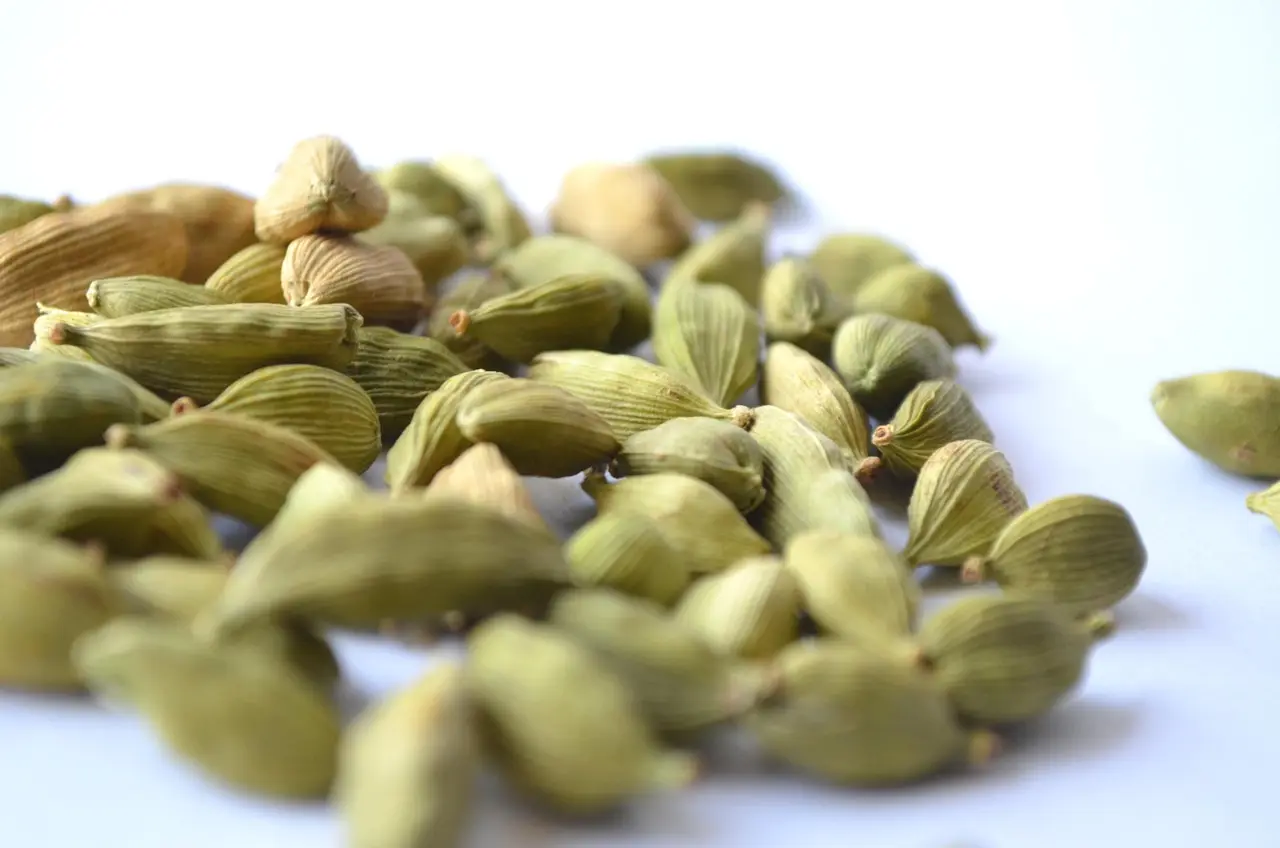
Crack a green cardamom pod and the scent reaches you before the seeds do. Those tiny black seeds have flavoured Indian sweets, Arabic coffee and Swedish buns for centuries, and they still rank as the third most expensive spice in the world, after saffron and vanilla 1. Cardamom comes from the rainforest hills of south India, and it has spent a few thousand years making itself at home everywhere else.
Background
Green cardamom is the seed pod of Elettaria cardamomum, a ginger-family plant native to India and South-East Asia 1. Its smoky, camphor-scented cousin, black cardamom (Amomum subulatum), grows in the eastern Himalayas 1. The genus name Elettaria traces back to ēlam, a Dravidian word, which tells you where the plant's story starts 1.
In India the heartland is Kerala. The Western Ghats of Idukki district are known simply as the Cardamom Hills, and the crop, alongside pepper, has given hill farmers there a steady living 2.
A tip worth stealing: buy whole pods. Ground seeds lose their flavour fast, and grinding husk and seed together lowers the quality 1. As a rough swap, ten pods give about one and a half teaspoons of ground cardamom 1.
History
Cardamom shows up very early. Wikipedia's summary of the scholarship places its first mentions in Sumer and in Ayurvedic texts 1. A version of its Greek name, ka-da-mi-ja, appears in Linear B on spice tablets from the House of the Sphinxes at Mycenae 1. The Greek physicians Hippocrates and Dioscorides wrote about it as a digestive aid, and by 126 CE it sat on the list of spices taxed on import at Alexandria 1. In the Middle Ages, Venice became the main gateway for cardamom into Europe, traded with pepper, cloves and cinnamon 1.
Then came the Vikings. Or did they? Plenty of Swedes grow up hearing that Norse traders found cardamom in the bazaars of Constantinople about a thousand years ago and carried it home 34. Culinary archaeologist Daniel Serra is not convinced. "We don't have much evidence of import spices being used during the Viking Age," Serra told America's Test Kitchen 3. Serra's theory credits the Moors, who arrived in Spain and Portugal in the eighth century: the first Scandinavian record is a 13th-century Danish cookbook, Libellus de Arte Coquinaria, whose cardamom recipes look almost identical to Moorish ones 34. Both stories are still told; only one has a manuscript behind it.
The modern twist happened in Central America. A German coffee planter, Oscar Majus Kloeffer, brought cardamom to Guatemala before the First World War 1. By 1979–80 Guatemala out-produced India, and today India, Indonesia and Guatemala grow about 85 per cent of the world's supply 1. Most of Guatemala's harvest is exported, while India eats about 95 per cent of its own 1.
Customs, rules and rituals
Coffee as welcome. In parts of the Middle East, coffee is ground and brewed with cardamom, sometimes in blends of up to 40 per cent 1. UNESCO lists Arabic coffee as intangible cultural heritage for the UAE, Oman, Qatar, Saudi Arabia and Jordan, and the rules are as much part of it as the brew: elders and guests are served first, the pourer uses the right hand, and you shake your little cup when you've had enough 5. It is served at weddings, tribal gatherings and majalis, the councils where disputes get settled 5.
Indian kitchens. Green cardamom goes into masala chai and traditional sweets, garnishes basmati rice and belongs in garam masala 12. Kerala's own sweets lean on it too 2. Some people chew the seeds like gum 1.
Nordic bakeries. Sweden has a whole day, 15 May, for kardemummabullar, its cardamom buns 4. Norway bakes cardamom into julekake at Christmas, Denmark into fastelavnsboller, cream-filled buns for the weeks before Lent, and Finland into pulla 14. The spice also lands in rice pudding and mulled glögg 4.
Place in human experience
Few spices travel this far from home and get adopted this completely. According to UN data quoted by America's Test Kitchen, Sweden eats 18 times more cardamom per person than the median country, and Norway nearly 30 times more 3. Cookbook author Johanna Kindvall told the same writer that cardamom buns mean "home" 3. A tropical seed from Kerala became the taste of a cold northern kitchen.
In the Gulf, cardamom coffee carries a different weight. UNESCO describes the coffee ritual as a symbol of generosity and respect, passed on informally from one generation to the next, often alongside poetry and conversation 5. Pouring it well is a way of saying who matters in the room.
And the Viking myth? It tells you something too. People like their favourite flavours to have heroic origins. The evidence points to a quieter route: merchants, cookbooks and centuries of trade running north from Moorish Spain and Portugal 34. Next time you split a pod over a pot of rice or a bowl of dough, you're handling one of the oldest traded goods on earth.
Sources
- "Cardamom", Wikipedia, https://en.wikipedia.org/wiki/Cardamom
- "Cardamom", Kerala Tourism, Government of Kerala, https://keralatourism.org/shopping-options/shop-cardamom-spice-kerala/11
- Steve Dunn, "Cardamom: How Did It Become Scandinavia's Favorite Spice?", America's Test Kitchen (2021), https://www.americastestkitchen.com/articles/3076-cardamom-how-did-it-become-scandinavia-s-favorite-spice
- Alba Caraceni, "How Indian Cardamom Became A Scandinavian Staple Spice", Food Republic (2025), https://www.foodrepublic.com/1750865/indian-cardamom-scandanavian-spice-staple
- "Arabic coffee, a symbol of generosity", UNESCO Intangible Cultural Heritage, https://ich.unesco.org/en/RL/arabic-coffee-a-symbol-of-generosity-01074