Galangal
Galangal looks like ginger's tougher cousin: a knobbly rhizome from the same plant family . The taste surprises people. Tasters call it flowery, or ginger…
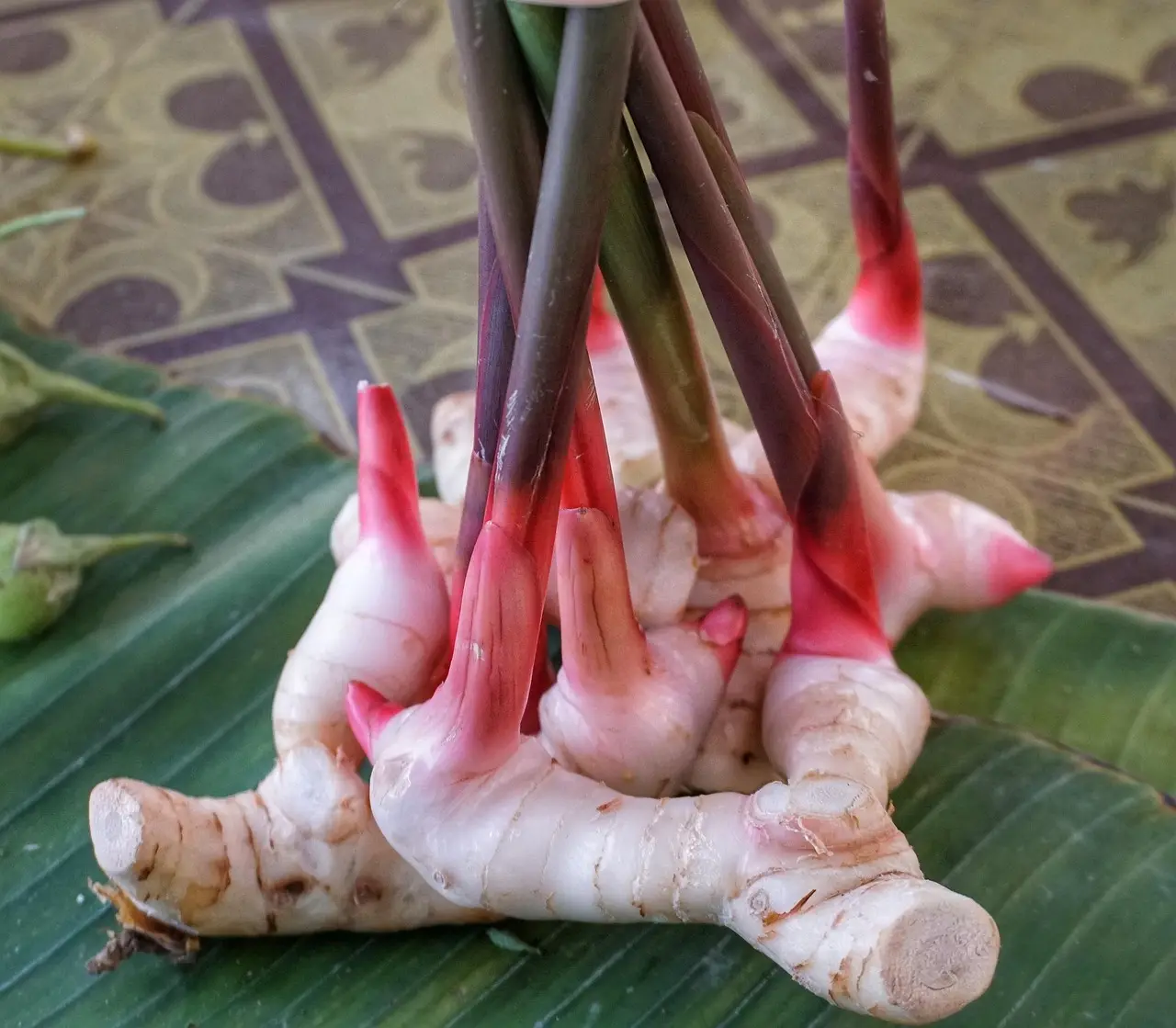
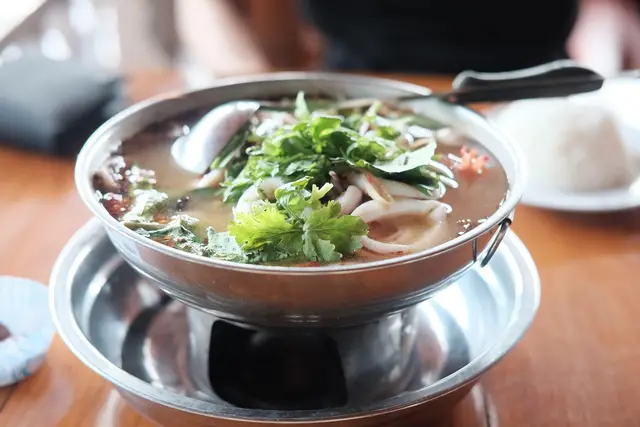
Galangal looks like ginger's tougher cousin: a knobbly rhizome from the same plant family 2. The taste surprises people. Tasters call it flowery, or ginger with cardamom, or peppery cinnamon 24. It is the backbone of Thai tom kha and tom yum and of curry pastes across Southeast Asia 2. And for a few hundred years, medieval Europe loved it too, then mostly forgot it.
Background
"Galangal" covers several plants in the ginger family 2. The one in most Asian kitchens is greater galangal, Alpinia galanga, also called lengkuas, laos, or kha in Thai 23. Lesser galangal, Alpinia officinarum, from southern China, is smaller, hotter and more medicinal; that was the one medieval Europe prized 24. Two more rhizomes, fingerroot and kencur, sometimes share the name 2.
In Thailand, cooks drop fresh chunks or thin slices into soups 3. Cambodia pounds it into kroeung paste; Indonesia uses it in soto and opor 2.
History
Greater galangal is native to South and Southeast Asia, and during the spice trade its main centre of cultivation was Java 3. The name probably came west through Persian qulanjan or Arabic khalanjan, which may themselves adapt a Chinese name 3. The UCLA Biomedical Library traces the Chinese original to a phrase meaning "mild ginger" 4.
Daniel Hanbury, a Victorian pharmacologist who chased the spice through old records, pieced together its journey west 1. Writing in 1871, he found the 9th-century writer Ibn Khurdádbah listing galangal among eastern exports with musk, aloes-wood and camphor. Arab physicians of the 10th and 11th centuries used it often 1. By the 13th century it travelled through Aden and Egypt to the port of Acre 1.
From there Europe took to it. The German abbess Hildegard of Bingen, who died in 1179, wrote about its healing powers 12. In 1252 it appeared on a customs tariff at Collioure, in southern France, beside cinnamon and cloves 1. King John of France bought it three times in 1359–60, and English price records from 1264 to 1376 show it selling for between 1s 6d and 6s 8d a pound 1. Marco Polo reported it growing in southern China and Java 1, and in 1563 the Portuguese physician Garcia d'Orta first told the small, strong Chinese kind apart from the thicker Javanese one 1.
Chaucer shows how ordinary it had become. In The Canterbury Tales, the pilgrims' Cook boils chicken with marrowbones, "poudre-marchant tart, and galingale" 5. A cookbook from around 1420 even uses it, with cumin and pepper, in a recipe called goose in hodgepodge 6. Then it faded. An 1880 source quoted by UCLA says Arabs and Greeks once used it much, "but it has now become obsolete here" 4.
Thailand's most famous galangal dish is younger than many expect. Tom kha, literally "boiled galangal", was first recorded in a Thai recipe book around 1890, made with duck rather than chicken 7.
Customs, rules and rituals
Galangal turns up in drinks as often as dinners. Russians flavoured vinegar, beer and a liqueur called nastoika with it, and Tartars took it with tea 14. Poland's Żołądkowa Gorzka vodka still uses it 2. The Mansaka people of the Philippines fermented the rhizome with honey into a wine called byais 3.
It shows up in medicine and belief too. Unani medicine knew it as khulanjan and used it for coughs and sore throats; Ayurveda calls it rasna; Tamil Siddha healers pair it with liquorice root for colds 3. In African American hoodoo, galangal became "chewing John" or "court case root" 3. And among the Kavalan people of Taiwan, children made a toy, the nanel, from its leaves 3.
Place in human experience
Galangal is a good reminder that taste is fashion. To a 14th-century English cook it was a luxury worth buying by the pound 15. To an English writer in 1880 it was obsolete 4. To a cook in Bangkok it never stopped being the smell of home. The same root reads as exotic, everyday or old-fashioned depending on where and when you stand.
It also shows how food and medicine once overlapped. Hildegard valued it as a remedy as much as a seasoning 12, and the medieval line between spice cupboard and medicine chest barely existed.
Some modern cooks would like it back in Western kitchens. The medievalist blogger Jeff Sypeck jokingly launched a "Crusade for the Restoration of Galangal in the West" and brewed galangal ale, which tasted "like mustard and perfume intermingled" 6. You might prefer a bowl of tom kha.
Sources
- Daniel Hanbury, "Historical Notes on the Radix Galangae of Pharmacy", The American Journal of Pharmacy (1871), via Henriette's Herbal Homepage, https://henriettes-herb.com/eclectic/journals/ajp/ajp1871/10-galangal.html
- "Galangal", Wikipedia, https://en.wikipedia.org/wiki/Galangal
- "Alpinia galanga", Wikipedia, https://en.wikipedia.org/wiki/Alpinia_galanga
- "Galangal", Medicinal Spices Exhibit, UCLA Biomedical Library, https://unitproj.library.ucla.edu/biomed/spice/index.cfm?displayID=29
- Geoffrey Chaucer, The Canterbury Tales (General Prologue), Project Gutenberg, https://www.gutenberg.org/files/22120/22120-h/22120-h.htm
- Jeff Sypeck, galangal posts, Quid Plura?, https://quidplura.com/category/galangal/
- "Tom kha kai", Wikipedia, https://en.wikipedia.org/wiki/Tom_kha_kai