Mortar and Pestle
A bowl, a club, and a bit of elbow grease. That's the whole kit, and people have used it for at least 35,000 years . Stone Age foragers crushed grain in…
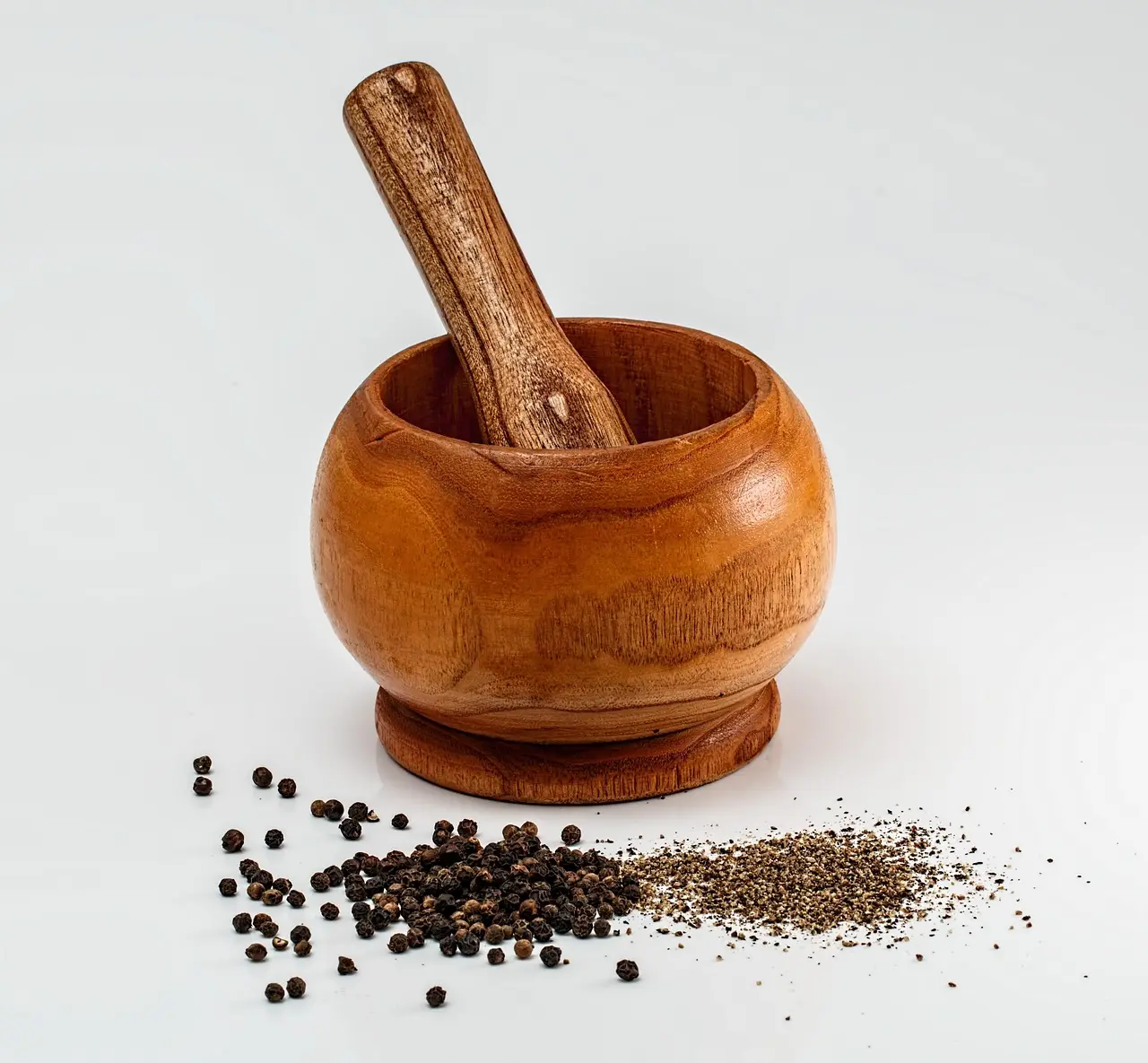
A bowl, a club, and a bit of elbow grease. That's the whole kit, and people have used it for at least 35,000 years 1. Stone Age foragers crushed grain in it. Aztec and Maya cooks made sauces in it. Apothecaries put one over the shop door. And tonight, somewhere, a Thai cook is bashing green papaya and a Genoese nonna is pounding basil in one 13. Few things in your kitchen link you so directly to the very first people who cooked.
Background
The trick is simple: crush and grind, and food gives up its oils and smells. The names come from Latin. "Mortar" goes back to mortarium, a bowl for pounding; "pestle" to pistillum, "pounder" 1. Here's the fun bit: Italian pesto shares that root. The sauce is literally named after the stick 1.
Every kitchen culture shapes its own. Mexico's molcajete is carved from a single lump of porous volcanic basalt, usually on three stubby legs, with a basalt pestle called a tejolote 3. Both words come from Nahuatl, the Aztec language 3. Japan uses a ridged bowl, the suribachi, and a wooden surikogi 1. Indonesian cooks crush sambal in a shallow cobek with a squat ulekan; Malaysians call theirs batu lesung 1. Thailand, India and Pakistan favour heavy granite, and West African cooks hull grain in tall wooden mortars 1.
History
The mortar is older than farming. Archaeologists have found them in Southwest Asia dated to about 35,000 BC, and the Kebaran people of the Levant ground grain in cone-shaped stone bowls between about 22,000 and 18,000 BC 1.
Now for the best story. In the Raqefet Cave near Haifa, in Israel, researchers from Stanford and the University of Haifa scraped residue from 13,000-year-old stone mortars at a Natufian burial site 2. They expected plant food. They found beer 2. Wheat and barley had been sprouted into malt, mashed, heated and left to ferment with wild yeast, probably into something closer to a thick porridge than a pint 2. Stanford's Li Liu calls it the oldest record of man-made alcohol yet found, brewed, the team thinks, for feasts honouring the dead 2. Some of the first serious grinding, it turns out, went into a drink.
Across the ocean, the molcajete goes back to pre-Hispanic Mesoamerica. Archaeologists have dug up giant ones, some with lids, thought to have gone into the graves of important people 3. After the Spanish arrived with pigs, a carved pig's head became the favourite decoration on the rim 3.
In Europe, medicine took over. The Roman poet Juvenal already used both words for drug-making gear 1. From the 1300s, bronze beat stone for alchemy and early chemistry 1. But metal could flake into medicines and react with acids. In 1779 the potter Josiah Wedgwood came up with a hard, glassy stoneware that shrugged off acid and soaked up nothing 5. Wedgwood sold the mortars and even gave them free to people doing chemical research, and kept making them well into the twentieth century 5. In 1923 F. Kurt Retsch built the first automatic mortar grinder 1, though nobody seems to have told the cooks.
There's a harder chapter too. Enslaved West Africans carried the know-how of the tall wooden rice mortar to the American South 1. Through the mid-1800s, African-American workers in the rice industry husked grain in mortars of West African design, then tossed it clean in wide winnowing baskets 6.
Customs, rules and rituals
Japan has the loudest mortar party of all: mochitsuki, "pounding rice cake" 4. Steamed sticky rice goes into a big usu mortar. One person swings a heavy wooden kine mallet; the other darts in between blows to turn and wet the dough. Lose the rhythm and someone gets a mallet on the hand 4. Mochi was once food for emperors and nobles and only reached ordinary homes in the Edo period (1603–1868) 4. At New Year, families set round "mirror" cakes, kagami mochi, on the home altar, beside the New Year pine and by the door, and eating mochi on New Year's Eve is said to keep your relationships stuck together for another year 4. Japanese American and Japanese Canadian communities still gather to pound it every winter 4.
In India, the mortar shows up at weddings too, crushing turmeric in Hindu ceremonies, as well as grinding the spice blends behind countless curries 1. And in Mexico, a molcajete is treated like a cast-iron pan: the stone "seasons" with use, so each salsa carries a whisper of the last, with a texture no blender can fake 3.
Place in human experience
Mortars turn up in the stories people tell their children. Baba Yaga, the witch of Slavic folklore, flies through the forest standing in a giant wooden mortar, clearing the path with her pestle 1. In East Asian tradition, there's a rabbit on the moon, pounding away at the elixir of life, or rice for mochi, depending on who tells it 1. And in the Hindu tale of the churning of the ocean, a pestle features in the making of the nectar of immortality 1.
Pounding is also a team sport. In the Philippines, several people pound rice together in a long hardwood mortar called bangkang pinawa, and tradition holds that the word for mortar, lusong, gave the island of Luzon its name 1. Writer Edward Moreno describes mochitsuki as a shared act of purification, everyone's effort beaten into one dough 4. And at Raqefet, the brewing mortars sat among the graves, which the researchers read as a bond between the living and their ancestors 2.
The tool even became a symbol you could trust. Medieval pharmacists and doctors had mortars carved on their gravestones, and the mortar and pestle still signals "pharmacy" today 1.
So next time you crush garlic by hand and the smell hits you, you're doing exactly what someone did in a cave 35,000 years ago. Just with better garlic.
Sources
- "Mortar and pestle", Wikipedia. https://en.wikipedia.org/wiki/Mortar_and_pestle
- Melissa De Witte (Stanford University), "Our taste for beer may go back 13,000 years", Futurity, 13 September 2018 (study in Journal of Archaeological Science: Reports, DOI 10.1016/j.jasrep.2018.08.008). https://www.futurity.org/beer-agriculture-ancient-history-1864102/
- "Molcajete", Wikipedia. https://en.wikipedia.org/wiki/Molcajete
- Edward Moreno, article on mochi and mochitsuki, Discover Nikkei (Japanese American National Museum), 31 December 2009. https://discovernikkei.org/en/journal/2009/12/31/mochi-food/
- "Mortar and pestle", Josiah Wedgwood and Sons, Victoria and Albert Museum collections. https://collections.vam.ac.uk/item/O1767143/mortar-and-pestle-josiah-wedgwood-and/
- "Rice mortar and pestle, mid-19th century", Digital History, University of Houston. https://www.digitalhistory.uh.edu/exhibits/reconstruction/section3/section3_05.html