Cumin
Toast a spoonful of cumin seeds in a dry pan and, about thirty seconds in, the kitchen smells warm, earthy and a little smoky. That smell travels further…
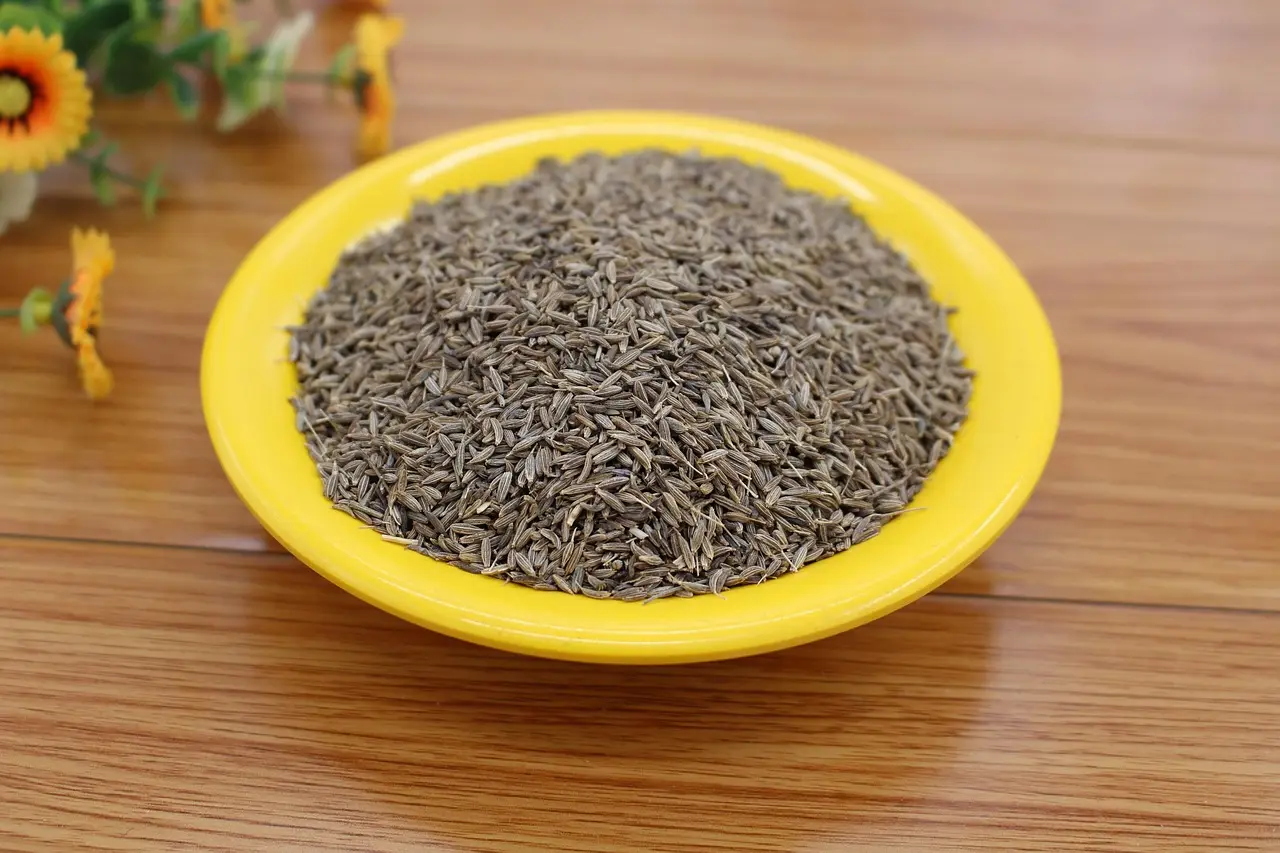
Toast a spoonful of cumin seeds in a dry pan and, about thirty seconds in, the kitchen smells warm, earthy and a little smoky. That smell travels further than almost any other in the spice rack. Cumin is the dried seed of Cuminum cyminum, a small plant in the parsley family 12, and it turns up everywhere: in Indian garam masala, Mexican chilli powder, Dutch cheese and French bread 2. Few spices have been on the table this long, or in this many kitchens.
Background
The plant is a slender cousin of fennel, carrot and caraway 13. The Online Etymology Dictionary describes it as growing wild in Egypt and Syria 3, while UC Davis's Nutritional Geography project places its native range across the Mediterranean and east to India 1. Botanists still argue about the exact birthplace; Central Asia, south-west Asia and the eastern Mediterranean all have backers 2.
Today India grows the lion's share, roughly 70% of the world's crop 2, and Mexico, North Africa, Chile and China grow it too 2. In Indian kitchens the seeds usually get a quick sizzle in hot fat first, to "wake up the flavour" 4.
History
Cumin has a long paper trail, and a longer seed trail.
- The oldest seeds. Wild cumin seeds turned up at Atlit-Yam, a village now under the sea off the coast of Israel, dated to the early 6th millennium BC 2. Syrian sites from the 2nd millennium BC and New Kingdom Egyptian sites hold cumin too 2.
- Egypt. The ancient Egyptians called it tpnn. Healers used it for upset stomachs and worms, and in mouth rinses and ear drops. Pharaoh Ramesses III even offered cumin to the sun god Ra at Heliopolis 1. Some accounts say it played a part in mummification 2.
- Minoan Crete. Palace store records written in Linear A carry a sign for cumin 2.
- Greece and Rome. Greek diners kept cumin on the table in its own little pot, the way we keep pepper 2. Pliny the Elder called it the most agreeable seasoning of all 1, and the Roman cookbook attributed to Apicius used it with grilled fish and marrows 1, and even in a pear omelette 4.
- The name. The word itself is a souvenir of trade. English cumin comes through Latin cuminum and Greek kyminon, which share their roots with Hebrew kammon and Arabic kammun 3. Wikipedia traces the line further back to Akkadian kamūnu and Sumerian gamun 2. One small seed, five or six empires.
- Medieval England, then Spain, then the Americas. Cumin was a hit in medieval England until caraway elbowed it aside 4. Spain stayed loyal, and Spanish and Portuguese colonists carried it to the Americas 24, where it settled so happily it now flavours almost every chilli powder blend 4.
Customs, rules and rituals
Cumin turns up in both Isaiah and Matthew, and both times the point is care. Isaiah describes farmers beating cumin out gently with a rod rather than running a cart wheel over it 5. In Matthew, Jesus scolds religious leaders who carefully tithe "mint, dill, and cumin" but neglect "justice and mercy and faith" 5. Cumin was valuable enough to tax, and small enough to make a point.
Rome had its own joke. Emperor Antoninus Pius, who ruled from AD 138 to 161, earned the nickname "cumin seed splitter" for being frugal, though food writers often pin it on his successor Marcus Aurelius by mistake 4.
Medicine and food never separated for long. Ayurvedic texts treat crushed cumin, sometimes rolled into pills with ghee, as a digestive and appetite booster 1. Iranian traditional medicine used it for toothache and stomach trouble; Tunisian healers gave it to new mothers; Italian folk medicine treated it as a bitter tonic 6. In Egypt today, cumin water is still a home cure for colic and indigestion, especially for pregnant women and new mothers 1.
Place in human experience
Cumin is a good example of a spice that belongs to everyone and no one. Egyptian, Hebrew, Greek, Roman, Arab, Indian and Mexican cooks all treat it as their own, and they are all right 124.
It also shows how food and moral life tangle together. The seed shows up in scripture as a symbol of small, fussy duties 5, and in Roman gossip as shorthand for stinginess 4. That is a lot of meaning to load onto something the size of a grain of rice.
Mostly, though, cumin lives in the hands of home cooks and healers. The same seed that a pharaoh offered to a god 1 now sits in a jar by the stove, ready for a quick sizzle before the onions go in. For families in Egypt, India or Iran, its smell can mean dinner, a grandmother's remedy, or both at once 16.
Sources
- "Cumin", Nutritional Geography, University of California, Davis. https://nutritionalgeography.faculty.ucdavis.edu/?p=73
- "Cumin", Wikipedia. https://en.wikipedia.org/wiki/Cumin
- "cumin", Online Etymology Dictionary. https://www.etymonline.com/word/cumin
- "Cumin", CooksInfo. https://www.cooksinfo.com/cumin
- Isaiah 28:25–27 and Matthew 23:23, New Revised Standard Version Updated Edition, Bible Gateway. https://www.biblegateway.com/passage/?search=Isaiah+28%3A25-27%3BMatthew+23%3A23&version=NRSVUE
- R. K. Johri, "Cuminum cyminum and Carum carvi: An update", Pharmacognosy Reviews 5(9), 2011, via PubMed Central. https://www.ncbi.nlm.nih.gov/pmc/articles/PMC3210012/