Eggs
Eggs: from jungle fowl in Southeast Asia to Easter red eggs and the Seder plate, plus Aussie labels, sizes, storage and vegan swaps.
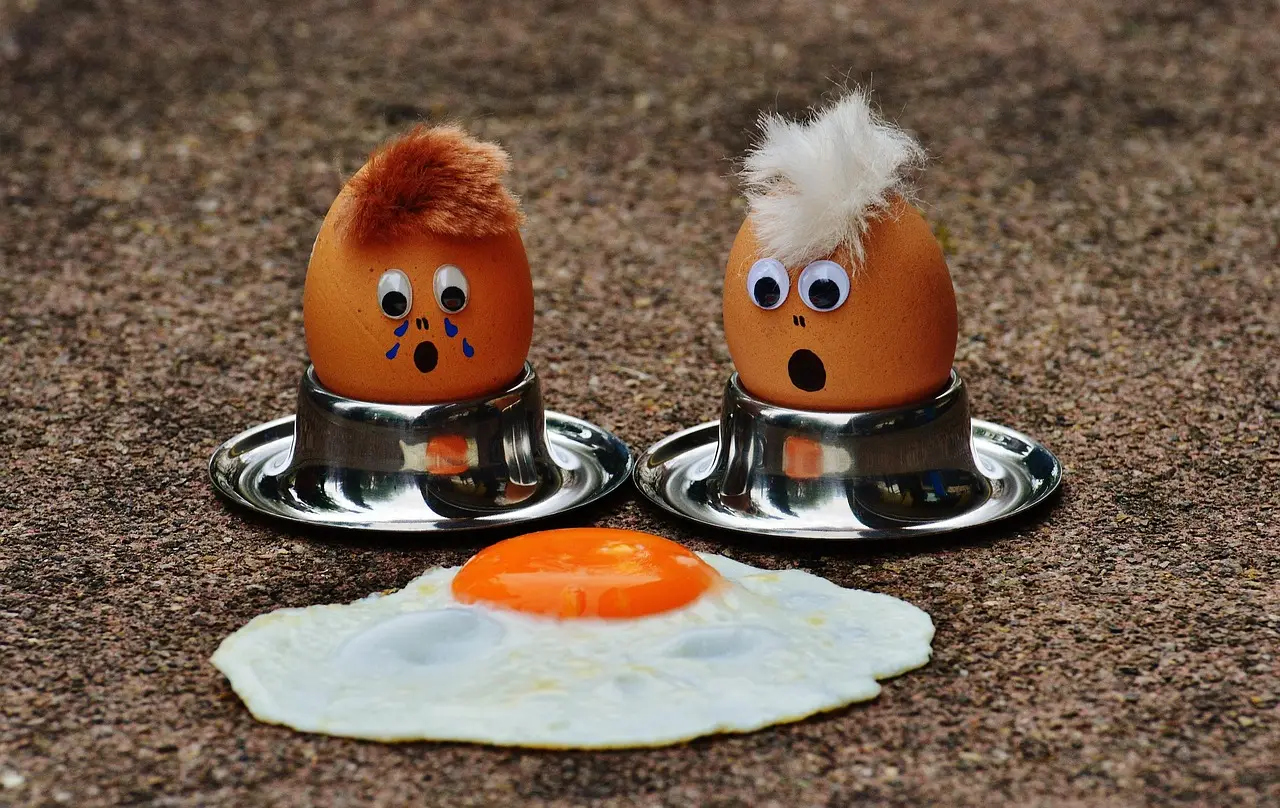
An egg is breakfast, glue, lift and sauce in one small shell. It binds a meatloaf, puffs a sponge, thickens a custard and turns oil into mayonnaise. Every culture that keeps chickens has found its own uses for eggs, and quite a few have found a meaning in them too.
Background
Most eggs we eat are chicken eggs. People domesticated chickens from jungle fowl native to Southeast Asia before 7500 BCE 1. The world laid 91 million tonnes of hen eggs in 2023 1. In 2017, China produced 31.3 million tonnes of the 80.1 million total, far ahead of any other country 1.
Shell colour comes down to breed, not nutrition. Hens with white earlobes tend to lay white eggs, and hens with red earlobes lay brown ones 1.
A large egg makes a decent start to the day. Australia's dietary guidelines count two large eggs (120 grams) as one serve from the meat, fish, eggs and alternatives group 2.
History
People in Southeast Asia were harvesting chicken eggs for food by about 1500 BCE 1. Chickens reached Egypt around that same time and Greece around 800 BCE 1.
Before the egg carton, there was the problem of Lent. In much of Christian Europe, eggs were off the menu for the weeks of fasting before Easter. When the fast ended, people ate them again, which made eggs a celebration food and helped make them the symbol of Easter 3. In medieval England, King Edward I's household accounts for 1290 record money spent on 450 decorated "pace eggs" for members of the royal household 3.
Customs, rules and rituals
- Red eggs at Easter. Early Christians in Mesopotamia dyed eggs red in memory of Christ's blood, and the custom spread through Orthodox Christianity into Eastern Europe and beyond 3. Orthodox believers still crack red eggs together while exchanging Easter greetings 3.
- Egg tapping and rolling. In egg tapping, players knock hard-boiled eggs together and the last unbroken one wins. In egg rolling, children roll eggs down a hill, a game that now happens every year at the White House 3.
- Chocolate eggs. J. S. Fry & Sons made the first hollow chocolate egg in 1873; Cadbury followed in 1875 3.
- Passover. The Seder plate holds a beitzah, a hard-boiled egg that is often roasted. It recalls the festival sacrifice once offered at the Temple in Jerusalem, and also mourning for the Temple's destruction 4. Some families start the meal with a boiled egg dipped in salt water, which represents the tears of the Israelites in slavery 4.
- Nowruz. Before the Persian New Year at the spring equinox, families decorate hard-boiled eggs 1.
Place in human experience
The egg is an easy symbol: something closed and still that holds new life. That's why it turns up at both ends of the year's big feasts, at Easter for the resurrection and on the Seder plate as "the circle of life: birth, reproduction, and death" 4.
It's also deeply ordinary. Eggs are cheap, quick and forgiving, the thing you cook when the fridge is nearly empty. Few ingredients sit so comfortably between the altar and the frying pan.
How to buy, store and use it
Reading the carton. Australian cartons are graded by the weight of a dozen: 600 g cartons hold eggs averaging 52 g, 700 g cartons average 60 g, and 800 g cartons average 68 g 5. Most recipes assume roughly a 700 g carton egg.
Cage, barn or free range. Cage eggs come from hens housed in cages in sheds, and make up about 40% of supermarket purchases 5. Barn-laid (cage-free) hens roam inside large sheds without cages. Free-range hens must have meaningful, regular access to the outdoors, with a maximum of 10,000 hens per hectare, and the carton must state the stocking density 5. Organic eggs need a certified logo 5.
Picking good ones. Open the carton before you buy. Don't buy cracked or dirty eggs, as they're more likely to carry Salmonella 6.
Where to find them. Australian supermarkets sell eggs in the chilled section or on a nearby shelf, depending on the store.
Storing them. Keep eggs in their carton, on a middle shelf of the fridge rather than in the door, where the temperature swings 7. Follow the date on the carton 7. To check an egg, put it in water: if it sinks and lies flat it's fresh, if it stands upright use it soon, and if it floats throw it out 7. Backyard eggs? Wipe dirt off with a dry cloth rather than washing, which can push germs inside 6.
Raw and runny eggs. For small children, pregnant women, older people and anyone with weakened immunity, skip raw-egg foods like homemade mayonnaise, aioli and mousse, and cook eggs until the yolk is firm 6.
Vegan swaps.
- Binding (cookies, patties): one tablespoon ground flaxseed plus three tablespoons water per egg.
- Whipped whites (meringue, mousse): aquafaba.
- Scrambled eggs: crumbled firm tofu with a pinch of turmeric.
Sources
- "Eggs as food", Wikipedia. https://en.wikipedia.org/wiki/Eggs_as_food
- "Serve sizes", Eat for Health, Australian Government National Health and Medical Research Council. https://www.eatforhealth.gov.au/food-essentials/how-much-do-we-need-each-day/serve-sizes
- "Easter egg", Wikipedia. https://en.wikipedia.org/wiki/Easter_egg
- "Passover Seder plate", Wikipedia. https://en.wikipedia.org/wiki/Passover_Seder_plate
- "Egg types and labels", Australian Eggs. https://www.australianeggs.org.au/farming/egg-types-and-labels
- "Eggs", Food Safety Information Council. https://www.foodsafety.asn.au/eggs/
- "Handling and storing eggs", Australian Eggs. https://www.australianeggs.org.au/facts-and-tips/handling-and-storing-eggs