Garlic
Crush a clove and the kitchen changes. That sharp, sulphury hit is garlic (Allium sativum), a cousin of onions and leeks, and it has followed people for…
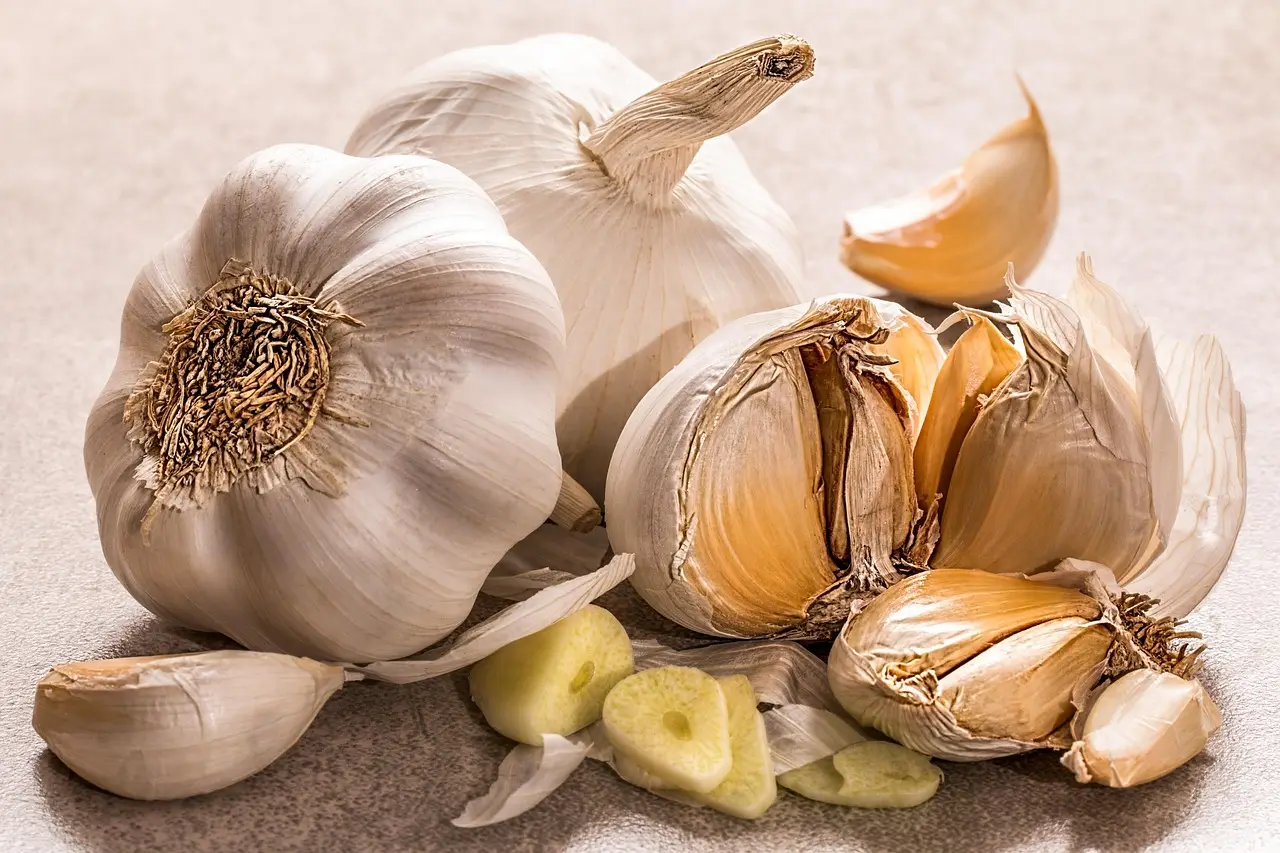
Crush a clove and the kitchen changes. That sharp, sulphury hit is garlic (Allium sativum), a cousin of onions and leeks, and it has followed people for thousands of years: into tombs, onto battlefields, around the necks of the nervous and, just as often, out of temples and monasteries altogether. It probably started life in Central Asia, though nobody can quite name its wild parent 16. Few ingredients have been loved, prescribed and banned with so much enthusiasm.
Background
Here's an odd thing: the garlic in your fridge almost never makes fertile seed. Growers plant cloves, not seeds, which makes its family tree a puzzle. Its closest wild relative, Allium longicuspis, grows in central and south-western Asia, but it's mostly sterile too, so botanists doubt it's the true ancestor 6. One review places garlic's homeland between western China's Tien Shan mountains and Kazakhstan and Kyrgyzstan 1.
These days China grows roughly three-quarters of the world's garlic, about 73% in 2024 6. And that famous smell? It doesn't exist until you cut or crush the clove. Whole, it's polite. Smashed, it's the loudest thing in the room.
History
Garlic turns up early and everywhere. Clay tablets show Mesopotamians growing it at least 4,000 years ago 6. A 2010 history in Pharmacognosy Reviews lists clay models of garlic bulbs in Egypt, the Ebers papyrus (around 1500 BC) recommending it for 32 ailments, and real bulbs dug up at Knossos on Crete 1. Tutankhamun went into his tomb, around 1325 BC, with garlic beside him 6.
Now for the best story, and the catch. The Greek traveller Herodotus visited Egypt around 454 BC and said an inscription on the Great Pyramid recorded 1,600 talents of silver spent on radishes, onions and garlic for the builders 2. Imagine the breath on that work site. But food historian Louis Grivetti at UC Davis points to research from 1968–69 that found no ancient Egyptian word for garlic and no sign of it in Egypt before Greek and Roman times 7. So enjoy the pyramid tale, but treat it as a tourist's report, not a receipt.
Greeks and Romans thought of garlic as food for soldiers, sailors and farmhands 6. Generals fed it to troops before battle, Olympic athletes reportedly chewed it before competing, and Hippocrates prescribed it 18. The Roman doctor Galen nicknamed it the "rustic's theriac", a cure-all for people who couldn't afford a real one 1.
Fast-forward to the twentieth century and Russian doctors used garlic so much for chest infections that the Red Army kept it on hand in the Second World War, earning it the nickname "Russian penicillin" 1.
Customs, rules and rituals
Most garlic rules boil down to one thing: the smell.
- Islam. Hadith record the Prophet asking anyone who'd eaten garlic to stay away from the mosque so the odour wouldn't bother others 4. Garlic itself is fine; the concern is raw garlic before group prayer 6.
- Buddhism. Early monastic rules allowed garlic only as medicine, mostly because it bothered fellow monks 3. Later Mahayana texts, including the Chinese Brahma's Net Sutra, banned five pungent plants: garlic, three kinds of onion and asafoetida. They framed it as kindness to others and grouped it with giving up meat and alcohol 3. Many monks and nuns in China, Korea, Vietnam and Japan still skip them 6.
- Daoism. One medieval Daoist rulebook says it plainly: don't eat garlic or the five pungent vegetables 3.
- Jainism. Strict Jains won't eat garlic, onions or other roots. Pulling up a bulb kills the whole plant, and roots are thought to hold countless tiny lives 5.
- Judaism. The Mishnah used "garlic eaters" as a nickname for one group, and Talmudic tradition recommends a garlic meal on Fridays 16.
- Persian New Year. Garlic, sir, sits on the haft-sin table among seven symbolic items 6.
Place in human experience
Garlic has always said something about class. Roman writers linked its smell to working people, and Galen's "rustic's theriac" tells you who ate it 1. Some ancient Greek temples, the 2010 review says, turned garlic eaters away at the door 1. The same bulb that powered labourers kept worshippers out.
Historian Filippo Costantini argues the Chinese taboo works through disgust: a private snack becomes a public nuisance and a spiritual stain 3. So if you've ever cooked garlic-free for a Jain friend or a visiting monk, you've joined a very old conversation about appetite, purity and good manners.
Garlic protects, too. European folklore had people wear it, hang it in windows or rub it on chimneys to keep vampires out 6. And in Korea it sits right at the nation's birth. In the Dangun legend, a bear and a tiger who want to become human must live in a cave on garlic and mugwort for 100 days. The tiger quits early. The bear sticks it out, becomes a woman and gives birth to Dangun, said by some scholars to have founded the first Korean kingdom in 2333 BC 9. Every garlicky Korean meal carries a little of that story.
Mostly, though, garlic just means dinner's on its way.
Sources
- Bauer Petrovska, B. and Cekovska, S., "Extracts from the history and medical properties of garlic", Pharmacognosy Reviews 4(7), 2010. https://pmc.ncbi.nlm.nih.gov/articles/PMC3249897/
- Herodotus, Histories 2.125, trans. A. D. Godley, Perseus Digital Library (Perseids). https://cts.perseids.org/read/greekLit/tlg0016/tlg001/perseus-eng2/2.125.6-2.125.7
- Costantini, F., "Disgusting vegetables: Wuxin taboo in Daoist prescription's texts", Rocznik Orientalistyczny 75(1), 2022, Polish Academy of Sciences. https://journals.pan.pl/Content/123795/PDF/ROrient%2075%20z.%201-22%209Costantini.pdf
- Sahih Muslim 563, "Mosques and Places of Prayer", Hadith Unlocked. https://hadithunlocked.com/muslim:563
- "Jain vegetarianism", Wikipedia. https://en.wikipedia.org/wiki/Jain_vegetarianism
- "Garlic", Wikipedia. https://en.wikipedia.org/wiki/Garlic
- Grivetti, L. E., "Garlic", Nutritional Geography, University of California, Davis. https://nutritionalgeography.faculty.ucdavis.edu/?p=83
- "From Ancient Egypt to the Science Lab to Your Dinner Plate: Garlic, It's Good for You", Weill Cornell Medicine Newsroom, 2006. https://news.weill.cornell.edu/news/2006/03/from-ancient-egypt-to-the-science-lab-to-your-dinner-plate-garlic-its-good-for-you
- "Dangun Wanggeom: Founder of the first Korean kingdom", The Korea Herald. https://www.koreaherald.com/article/10346707