Onions
Onions: why they make you cry, how Egypt buried pharaohs with them, a Swiss onion festival, and how to pick, store and cook them in Australia.
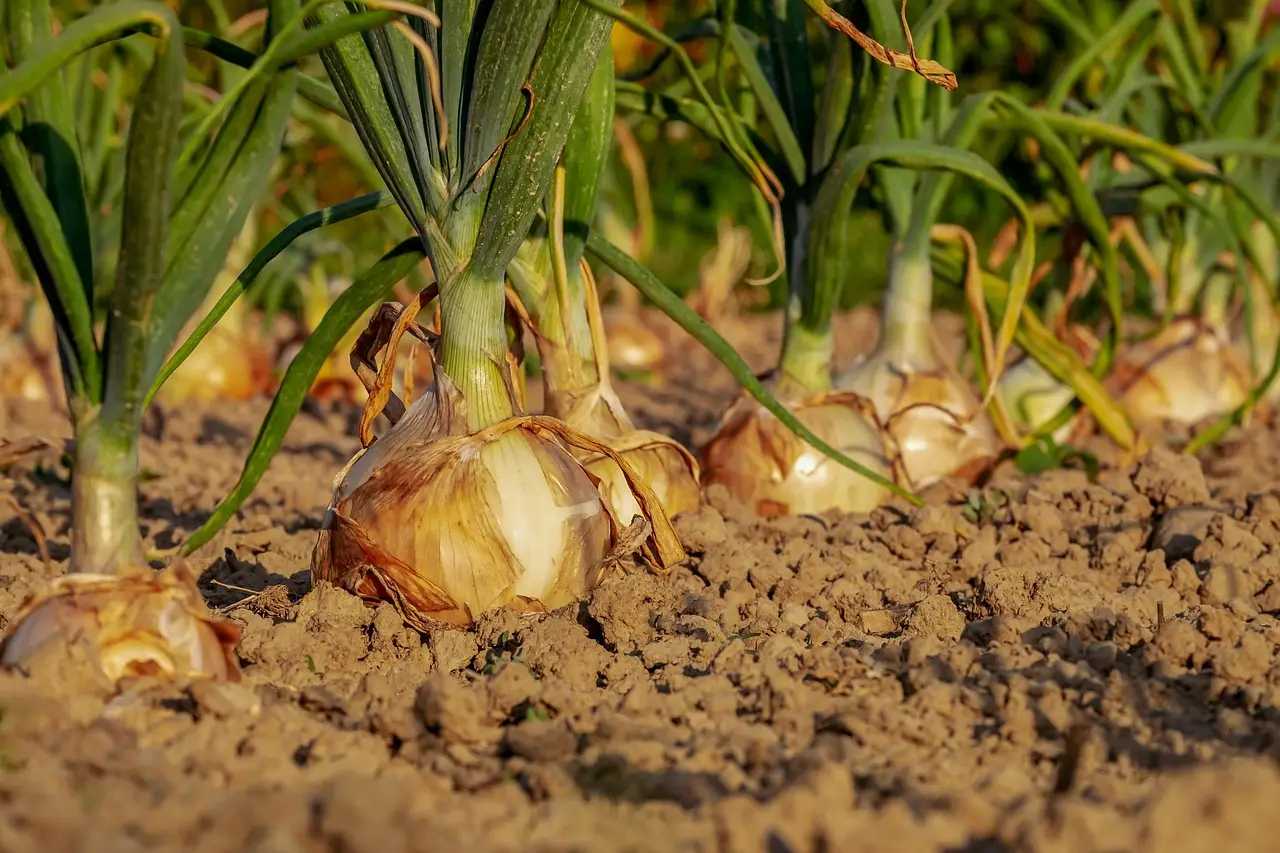
Almost every good dinner starts the same way: oil in the pan, an onion on the board, and somebody wiping their eyes. Onions are the quiet foundation of cooking. They rarely get the credit, but leave them out of a curry, a bolognese or a stew and you'll taste the hole straight away. People have grown and bred them for at least 7,000 years 1, buried kings with them and paid rent with them. Not bad for something so cheap.
Background
The onion, Allium cepa, is the most widely grown member of the Allium family 1. Gardeners usually treat it as an annual and harvest the bulb in its first season 1. Most experts think it was domesticated in West or Central Asia 15.
Now, the crying. Slicing an onion breaks open its cells and lets enzymes loose on sulphur compounds. The result is a gas called syn-propanethial-S-oxide, which drifts up and stimulates nerves in your eyes. Your tear glands respond by flooding them to wash it away 1. So the tears aren't sadness. They're plumbing.
History
Onions earned their place early because they were practical. The US National Onion Association sums it up: they kept longer than most foods, travelled well, grew easily and coped with all sorts of soils and climates 5.
The oldest known recipes in the world, written in cuneiform on the Yale culinary tablets around 2000 BC, use onions 1. Ancient Egyptians went further and revered them. They saw the bulb's round shape and rings within rings as symbols of eternal life 1. Traces of onion were found in the eye sockets of the mummified pharaoh Ramesses IV 1.
The Greek traveller Herodotus, visiting Egypt in the fifth century BC, reported writing on the Great Pyramid recording 1,600 talents of silver spent on radishes, onions and garlic for the workers 2. That was one tourist's report, not a receipt, but it shows how basic onions were to a working diet.
In Rome, Pliny the Elder recorded a long list of things people believed onions could do 1. And in medieval Europe, onions were valuable enough that people paid rent with them and gave them as gifts 1.
Customs, rules and rituals
- Burial for eternity. Egypt's use of onions in burials, as with Ramesses IV, ties the vegetable to the hope of life after death 1.
- Avoided for kindness. Strict Jains don't eat onions, garlic, potatoes or other root vegetables. They believe each root holds countless tiny lives, so pulling one up does great harm 3. Avoiding onions and garlic has pushed Jain cooks into real culinary invention 3.
- Bern's onion market. On the fourth Monday of November, Bern in Switzerland holds the Zibelemärit, its biggest market of the year 4. Around 50,000 kilograms of onions are sold, many braided into strings and wreaths, alongside onion tart, mulled wine and roasted almonds 4. In the afternoon the crowd breaks into a confetti battle 4. Legend says the market began as a thank-you to farmers who helped after a great fire in 1405; records show an autumn market by 1439 4.
Place in human experience
The onion is a working food. It fed pyramid builders, if Herodotus is right 2, and peasants paid their landlords with it 1. Yet the same bulb also sat in a pharaoh's tomb as a symbol of forever 1. Few foods have stretched so easily from the poorest table to the grandest burial.
Onions also give us one of cooking's most human moments: crying over a chopping board for no reason at all. Everyone who has ever made dinner for someone has done it.
How to buy, store and use it
Picking good ones. Choose onions that feel heavy and firm, with dry, papery skins. Skip any that are soft, sprouting or damp at the neck.
Where to find them. Every Australian supermarket sells brown, red and white onions, loose or in bags. Brown onions are the everyday cooking onion; red onions are milder and pretty raw in salads.
Storing. Keep cooking onions somewhere cool, dry and airy, ideally in a mesh bag. They last three to four weeks at room temperature 1. Sweet onions keep only one to two weeks out, or about a month in the fridge 1. Wrap cut onion and refrigerate it.
Pets. Onions are toxic to dogs, cats and guinea pigs 1, so keep scraps out of their bowls.
Using it. Sweat onions gently for sauces, caramelise them slowly for burgers and tarts, roast wedges with vegetables, or slice red onion thinly and soak it in vinegar for a quick pickle.
Swaps. Leeks or spring onions bring a gentler flavour. For a Jain-friendly or onion-free dish, lean on ginger, cumin and asafoetida.
Sources
- "Onion", Wikipedia. https://en.wikipedia.org/wiki/Onion
- Herodotus, Histories 2.125, trans. A. D. Godley, Perseus Digital Library (Perseids). https://cts.perseids.org/read/greekLit/tlg0016/tlg001/perseus-eng2/2.125.6-2.125.7
- "Jain vegetarianism", Wikipedia. https://en.wikipedia.org/wiki/Jain_vegetarianism
- "Zibelemärit", Wikipedia. https://en.wikipedia.org/wiki/Zibelem%C3%A4rit
- "History of Onions", National Onion Association (USA). https://www.onions-usa.org/all-about-onions/history-of-onions