Shallots
Peel a shallot and you'll find it's a little onion with better manners: purple-tinged layers, a milder bite, a gentle sweetness that melts into butter…
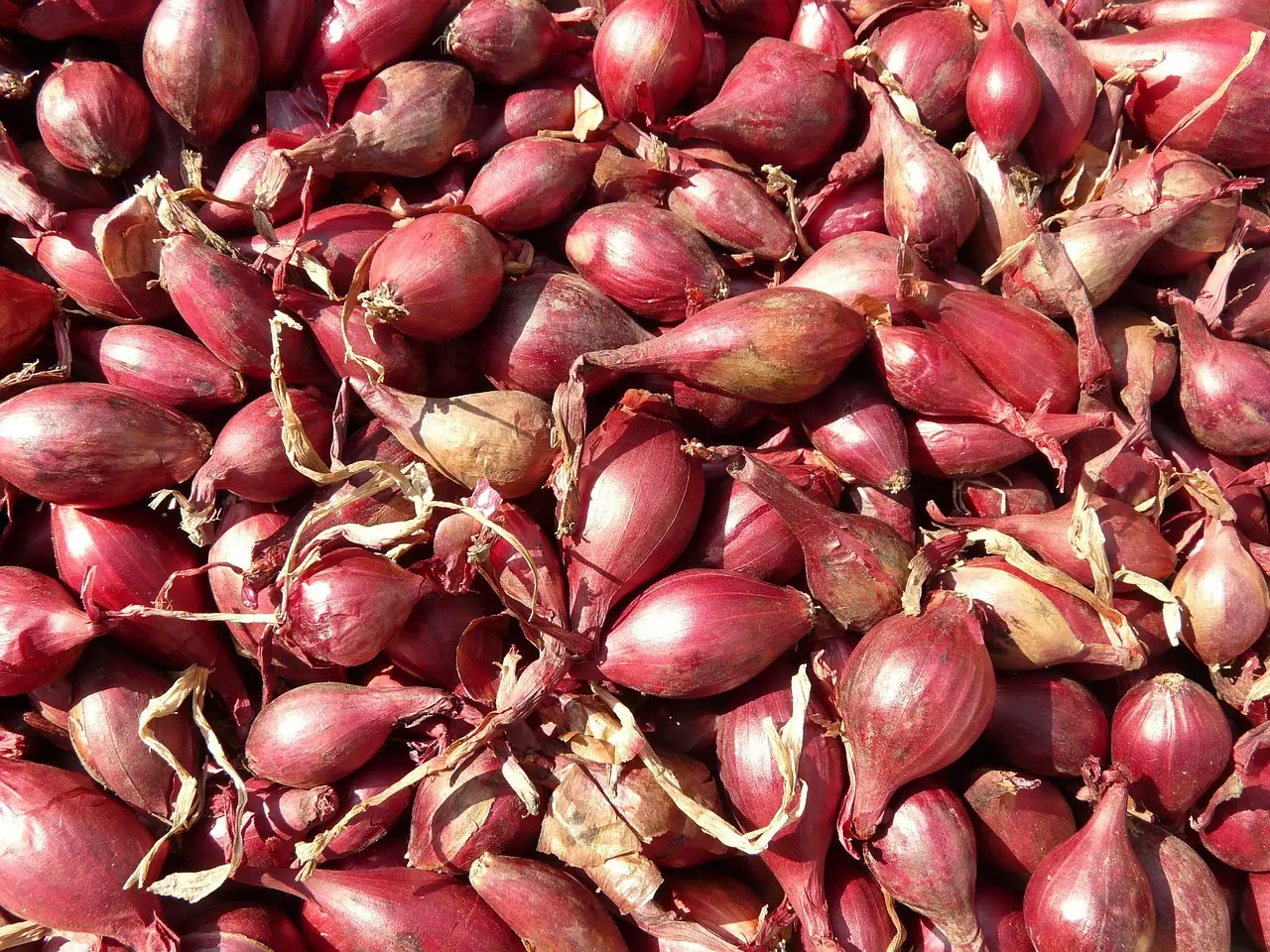
Peel a shallot and you'll find it's a little onion with better manners: purple-tinged layers, a milder bite, a gentle sweetness that melts into butter rather than shouting. Slice it thin and fry it, and it turns into golden, crackly chips that make almost any bowl of rice or soup better. Shallots have travelled from the mountains of Iran to the sauces of Paris and the street stalls of Jakarta. They've also got caught up in one of Australia's great kitchen arguments.
Background
Shallots belong to the onion family, and their home lies in Central and Southwest Asia, especially the Zagros Mountains between Iran and Iraq 1.
So what is a "shallot" in Australia? It depends where you live. In New South Wales people often say "shallot" for the long green scallion, also called a spring onion, which is why recipes here sometimes say "French shallot" or "eschalot" for the little bulb 1. English speakers in Quebec do the same thing 1. If a recipe confuses you, check whether it wants a bulb or a green stalk.
History
The name is a souvenir of an ancient port. "Shallot" comes from Old French eschalotte, from Latin Ascalōnia caepa, the "Ascalon onion" 1. Ascalon is Ashkelon, a city on the coast of today's Israel. "Scallion" comes from the same root 2.
Roman and Greek writers already knew the name. Pliny the Elder, in the first century AD, wrote of "the Ascalon onion, named for a town in Judaea", and the geographer Strabo called Ascalon's countryside "a good onion-market, though the town is small" 2. The Hebrew etymology blog Balashon notes that Ashkelon's coastal position made it a natural trading hub, so nobody can be sure whether the onions grew there or just passed through 2. The name stuck either way.
From there shallots found a second home in France, where they became essential to classic sauces such as béarnaise and beurre blanc 1.
Customs, rules and rituals
In Southeast Asia the shallot is a daily essential. Indonesians call it bawang merah, "red onion" 3. Cooks slice the small purplish bulbs thinly and deep-fry them into bawang goreng, then sprinkle them over steamed rice, nasi goreng, soto soup, chicken porridge (bubur ayam) and satay 3. They keep them in tight glass jars, and supermarkets sell them ready-made 3. Fried shallots appear across Indonesia, Vietnam, Thailand and their neighbours 1.
In South Asia, Sri Lankan cooks use shallots a lot, and southern Indian cooks often treat them as interchangeable with small red onions in curries 1.
Shallots also sit inside some of the world's oldest food rules, because several faiths avoid the onion family:
- Jains avoid onions, garlic and other root vegetables. Uprooting kills the whole plant, and each bulb is believed to hold countless tiny lives 4.
- Hindu sattvic eating, linked to yoga and Ayurveda, classes onion and garlic as tamasic, foods thought to dull the mind 5.
- Mahayana Buddhist monastics in China, Korea, Vietnam and Japan avoid the "five pungent spices", which traditionally include shallot. Sutras teach that their strong flavours stir up passion and irritability and disturb meditation 6.
So the same little bulb can be the heart of a French sauce and a thing a monk politely declines.
Place in human experience
Shallots carry a whole map in their name. Every time an English or French cook says "shallot", they're quietly naming a port city that traded onions two thousand years ago 12.
They also show how one ingredient can mean opposite things. To a Paris chef the shallot means refinement 1. To an Indonesian family it means a crunchy topping on everyday rice 3. To a Jain, a Hindu following a sattvic diet or a Buddhist monk, it means something to leave off the plate for the sake of the mind and the soul 456.
And they mean argument, the friendly kind. In New South Wales, a debate can start with "pass the shallots" and someone handing you the wrong one 1.
So next time you fry a handful into golden crisps, you're cooking with a plant from the Zagros, named after a Mediterranean port, and loved (or carefully avoided) across half the world.
Sources
- "Shallot", Wikipedia, Wikimedia Foundation. https://en.wikipedia.org/wiki/Shallot
- "Scallion", Balashon – Hebrew Language Detective, July 2006. https://www.balashon.com/2006/07/scallion_05.html
- "Bawang goreng", Wikipedia, Wikimedia Foundation. https://en.wikipedia.org/wiki/Bawang_goreng
- "Jain vegetarianism", Wikipedia, Wikimedia Foundation. https://en.wikipedia.org/wiki/Jain_vegetarianism
- "Sattvic diet", Wikipedia, Wikimedia Foundation. https://en.wikipedia.org/wiki/Sattvic_diet
- "Buddhist cuisine", Wikipedia, Wikimedia Foundation. https://en.wikipedia.org/wiki/Buddhist_cuisine