Spring onions
Spring onions, scallions, green onions, salad onions: whatever your family calls them, they are the slim, green-topped alliums that finish half the…
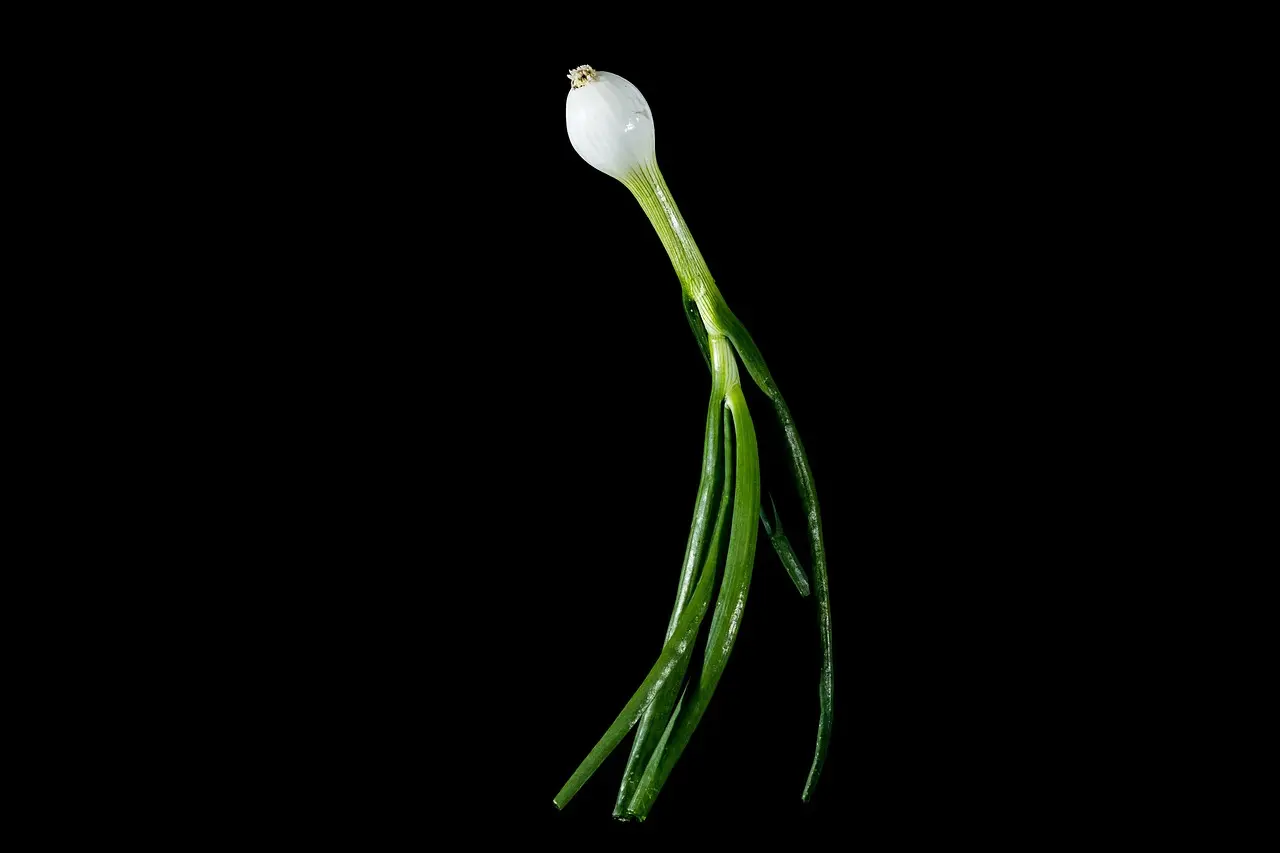
Spring onions, scallions, green onions, salad onions: whatever your family calls them, they are the slim, green-topped alliums that finish half the world's dinners. A handful of sliced green rings wakes up noodles, fried rice, omelettes and soups in seconds. The plant most often sold under these names in Asia is the Welsh onion, Allium fistulosum, which almost certainly comes from China, not Wales 1.
Background
The Welsh onion is a bit of a cheat among onions: it never forms a real bulb 1. Instead you get a long white stem and hollow green leaves, and the whole thing is eaten. Farmers in East Asia grow it in deep furrows and pile soil up around the stems as they grow, so the hidden part stays pale, tender and sweet. Those thick blanched stems go into dishes like Japanese sukiyaki, while cooks in South-East Asia lean on the green leaves for salads and soups 1.
It goes by plenty of names: ciboule in French, hành hoa in Vietnamese, bawang daun in Indonesian 1. And the English names hide two small surprises. "Welsh" comes from an Old English word meaning foreign, used for people who weren't Anglo-Saxon, so a "Welsh onion" is really just a foreign onion 5. "Scallion" goes back to the old Mediterranean port of Ascalon, now Ashkelon, through the Latin for "onion from Ascalon". It appears in English by the late 1300s and shares its roots with "shallot" 5.
History
The Welsh onion probably started out in north-western China. People were growing it there by at least 200 BCE, and the earliest written description appears in a Chinese text from about 100 BCE. It reached Japan before 500 CE, turns up in Japanese writing by 720 CE, and spread on into South-East Asia 1. Today it is grown worldwide, though East Asia is still its heartland 1.
Chinese doctors prized it too. Traditional medicine credits it with easing colds, headaches and wounds, and helping digestion 1. Early Daoist texts went further: scallions were a key ingredient in a sesame paste eaten as a longevity recipe 2.
Europe has its own green-onion legend. In Valls, near Tarragona in Catalonia, locals credit a farmer named Xat de Benaiges, in the late 19th century, with discovering calçots. These are white onions grown long and slender by heaping earth over the shoots, the same trick East Asian farmers use. The name comes from the Catalan calçar, to put on shoes, because the plants get "shod" in soil 4.
Customs, rules and rituals
Here the humble scallion gets surprisingly dramatic.
In Chinese Buddhism, monks and many devout lay people avoid the "five pungent vegetables", a group of strong alliums that includes onions and scallions. Fifth-century scriptures condemned them as unclean and smelly, and avoiding them came to be seen as kindness to fellow monks who had to share the meditation hall. One influential text, the Scripture of Brahma's Net, names garlic, three kinds of onion and asafoetida 2. The exact list never quite settled. Some Daoist rule books name scallions outright, and later lists even add coriander or ginger 2.
The idea is older than Buddhism in China. Ancient ritual texts asked people to skip pungent vegetables while fasting before a ceremony or wearing sacrificial robes, and a commentary on one of them names onion among the forbidden hun foods 2. Yet the same plants carried good luck: a Jin dynasty record describes plates of the five pungent vegetables prepared on New Year's Day, and a Tang dietary text recommends them as protection against harmful airs 2.
At Passover, Jewish families from Iran and Afghanistan bring out long scallions during the song "Dayenu" and gently whip each other around the table. Some say it recalls the slave drivers' whips in Egypt. Others link it to the Bible's Israelites, who missed Egypt's onions while wandering the desert, so the whipping becomes a playful telling-off for longing after slavery 3.
In Catalonia, winter brings the calçotada. Friends gather to char calçots over a fire, peel back the blackened skins, dunk the white stems in salvitxada sauce, and lower them into their mouths while wearing bibs. Valls hosts the Gran Festa de la Calçotada each year, with contests for growers, sauce makers and eaters. The record holder ate nearly six kilos in 2018 4. Calçots from Valls carry protected geographical status, with rules on stem length of 15 to 25 centimetres, and around 15 million certified calçots sold in 2019 4.
Place in human experience
Spring onions sit in an odd spot. They are about as everyday as food gets, yet religions have spent centuries arguing over them. The historian Yü Ying-shih observed that garlic and scallions were most likely to appear on the food lists of poor people in early China. The scholar Filippo Costantini notes the sources can't fully confirm that, and that their price could depend on who was eating them 2. What the texts do show is a plant that was everywhere, loved by doctors and cooks and avoided by the pious at the moments that mattered most 2.
That double life is the fun of it. The same green stalk that a monk turns down becomes a New Year's blessing, a Passover whip, or a Catalan party in a paper bib. Catalans describe a calçotada as a time to meet and talk about family and friends 4. Next time you scatter green rings over a bowl of noodles, you are carrying on one of the oldest and most argued-over habits in the kitchen.
Sources
- "Allium fistulosum (PROSEA)", Pl@ntUse, Pl@ntNet / Plant Resources of South-East Asia. https://plantuse.plantnet.org/en/Allium_fistulosum_(PROSEA)
- Filippo Costantini, "Disgusting vegetables: Wuxin taboo in Daoist prescription's texts", Rocznik Orientalistyczny LXXV (2022), Polish Academy of Sciences. https://journals.pan.pl//Content/123795/PDF/ROrient%2075%20z.%201-22%209Costantini.pdf
- "Whipping with Onions", in "Top 10 Things You Didn't Know About Passover", TIME. https://content.time.com/time/specials/packages/article/0,28804,2065531_2065534_2065848,00.html
- "Calçot onions, the quintessential Catalan delicacy", Catalan News. https://catalannews.com/life-style/item/calcot-onions-the-quintessential-catalan-delicacy
- "scallion" and "Welsh", Online Etymology Dictionary. https://www.etymonline.com/word/scallion and https://www.etymonline.com/word/Welsh