Mushrooms
Slice a mushroom into a hot pan with butter and wait. First it squeaks, then it sweats, then it goes golden and smells like a forest floor after rain.…
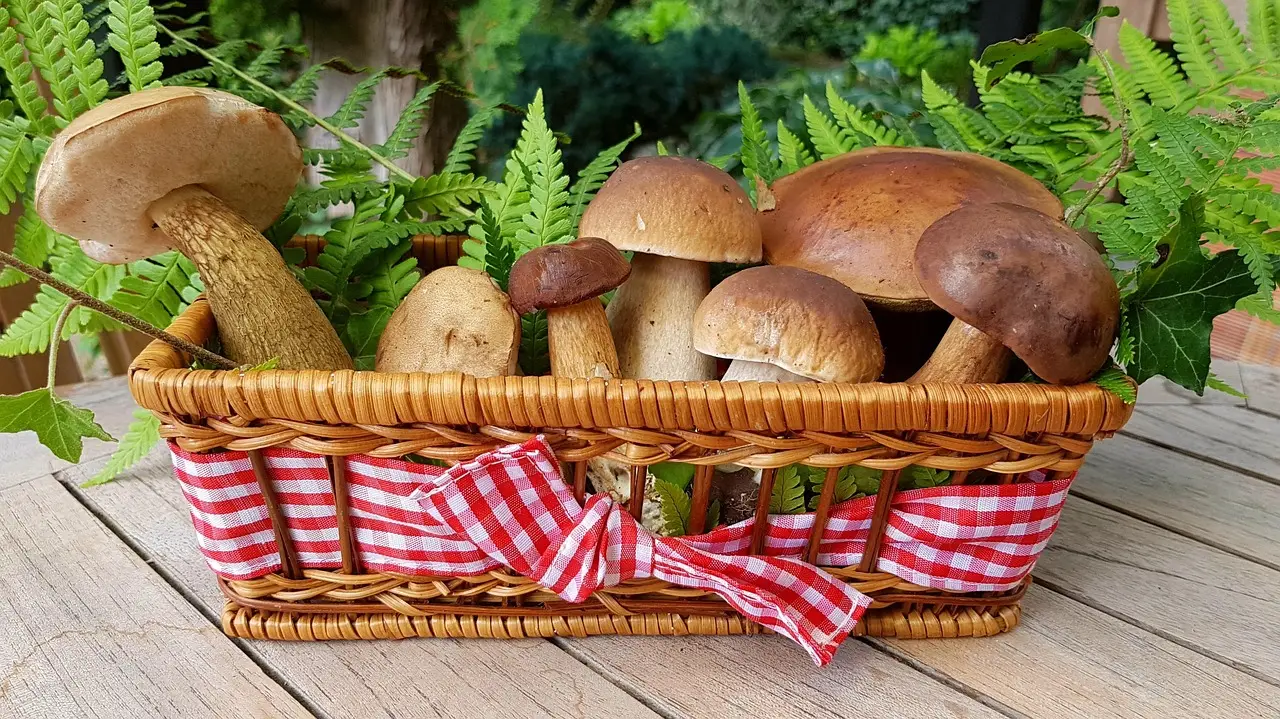
Slice a mushroom into a hot pan with butter and wait. First it squeaks, then it sweats, then it goes golden and smells like a forest floor after rain. That deep, savoury hit is umami, and dried shiitake carries more of it than almost anything in your pantry 1. A mushroom is the fruiting body of a fungus, the bit that pops up to spread spores. People have loved them, feared them and fought over them for thousands of years.
Background
Most mushrooms you buy are farmed: the little white button (the French call it champignon de Paris), its brown cousins, shiitake, oyster and enoki. More than twenty species are grown commercially in at least 60 countries, and China alone grew over 47 million tonnes in 2023 1.
Wild ones are another story. Every wild mushroom must be properly identified before anyone eats it, because the death cap, Amanita phalloides, kills 1. Russia counts about 30 poisonous varieties, and a single fragment of death cap can kill an adult 7. So the golden rule of mushroom cooking: if you can't name it, don't eat it.
History
Mushrooms were in our pockets before they were on our plates. Ötzi, the 5,000-year-old Iceman found in 1991 in a glacier on the Austrian–Italian border, carried pieces of birch polypore strung on cords, maybe as medicine, maybe as a razor strop. He also kept tinder fungus in a pouch, probably to carry fire from camp to camp 6.
The Romans gave mushrooms their most famous murder mystery. Emperor Claudius died on 13 October AD 54 after a mushroom dinner, and the old story blames his wife Agrippina, clearing the throne for her son Nero. A physician reviewing the symptoms at a University of Maryland conference reckoned they fit muscarine poisoning 5. Murder or bad luck? Two thousand years on, the jury is still out.
Farming began in China. The first written record of growing shiitake appears in the Records of Longquan County, compiled by He Zhan in 1209 2. Japanese growers later laid freshly cut shii logs beside logs already sprouting mushrooms, and in 1796 Satō Chūryō wrote Japan's first book on shiitake growing, drawing on that Chinese text 2.
The button mushroom owes its fame to a king with a craving. Louis XIV loved the then-rare champignon, and growers around Paris set out to supply it 3. The tale goes that quarry horses left manure in the tunnels under the city, wild spores moved in, and a grower named Chambry had the bright idea of carting manure underground on purpose. Down there the temperature never changed, so mushrooms grew all year 3. By 1880 Paris had more than 300 mushroom farms. Then the Métro arrived and pushed them out of town. Today only about five underground farms survive around Paris 3.
Customs, rules and rituals
Mushrooms are a gift to anyone skipping meat. Buddhist vegetarian cooks in China lean on shiitake in Buddha's Delight, and Japanese cooks build a meat-free dashi from them 2. Orthodox Christians in Russia fast on Wednesdays, Fridays and through four long fasts, giving up meat, butter, cheese, milk, sour cream and often fish 8. Mushrooms aren't on that list, so they stay on the table.
In Russia, picking is close to a national sport. The season runs from April to October, kids learn it young, and the haul gets boiled, fried or pickled 7. Bulgarians, Slovenians and Czechs go picking too, but pickling mushrooms is rare in Western Europe and the United States 7. Writer Dmitry Bykov joked that even Russian monuments look like they're out searching for mushrooms 7.
Place in human experience
Why do some families adore mushrooms while others won't touch them? One couple turned that question into a whole field of study, and it started on their honeymoon.
In 1927, in the Catskill Mountains, Valentina Pavlovna Wasson, raised in Russia, spotted wild mushrooms and gathered them with delight. Her new husband Gordon, brought up in an English-style household, refused to eat them, convinced they'd poison her. Next morning Valentina was very much alive, and Gordon rushed to the kitchen to eat a bolete 4. The pair went on to coin the words "mycophile" and "mycophobe" and to found ethnomycology, the study of fungi in human culture. Their research took them to Oaxaca, where the healer María Sabina showed them the ceremonial use of psilocybin mushrooms 4.
In Russia, cooks trace the habit of pickling and drying to hungry years, when the forest gave food for free. Today picking is more like meditation. Writer Alexander Genis calls it "a hide-and-seek with no winners or losers" 7. And a French chef in Moscow, raised in Burgundy, couldn't get over the abundance: back home you find a few types, but in Russia, everything 7.
Free food, hidden danger and know-how handed down by grandparents: no wonder mushrooms stick in memory. Next time you brown a panful, you're cooking with a royal craving, a Song dynasty farming manual and a honeymoon dare.
Sources
- "Edible mushroom", Wikipedia, Wikimedia Foundation. https://en.wikipedia.org/wiki/Edible_mushroom
- "Shiitake", Wikipedia, Wikimedia Foundation. https://en.wikipedia.org/wiki/Shiitake
- "Champignons de Paris: The Famous Mushroom and their City Farmers", France Today. https://francetoday.com/culture/made_in_france/champignons_de_paris/
- "Mycelium Wassonii" (review), North American Mycological Association. https://namyco.org/reviews/mycelium-wassonii/
- "Case Closed: Claudius Killed by Mushrooms", Scientific American. https://www.scientificamerican.com/article/case-closed-claudius-kill
- Tom Volk, "Fungus of the Month, December 2001: Piptoporus betulinus", University of Wisconsin–Madison. https://botit.botany.wisc.edu/toms_fungi/dec2001.html
- "What's up with the Russian lust for mushrooms?", Russia Beyond. https://www.rbth.com/russian-kitchen/329133-russian-mushrooms-love
- "Russian Fasting Traditions", Russian Life, March 1997. https://www.russianlife.com/magazine/march-1997/russian-fasting-traditions/