Tofu
Tofu is soy milk turned into curds and pressed into soft white blocks, much the way cheese is made from dairy milk. It has fed East Asia for more than a…
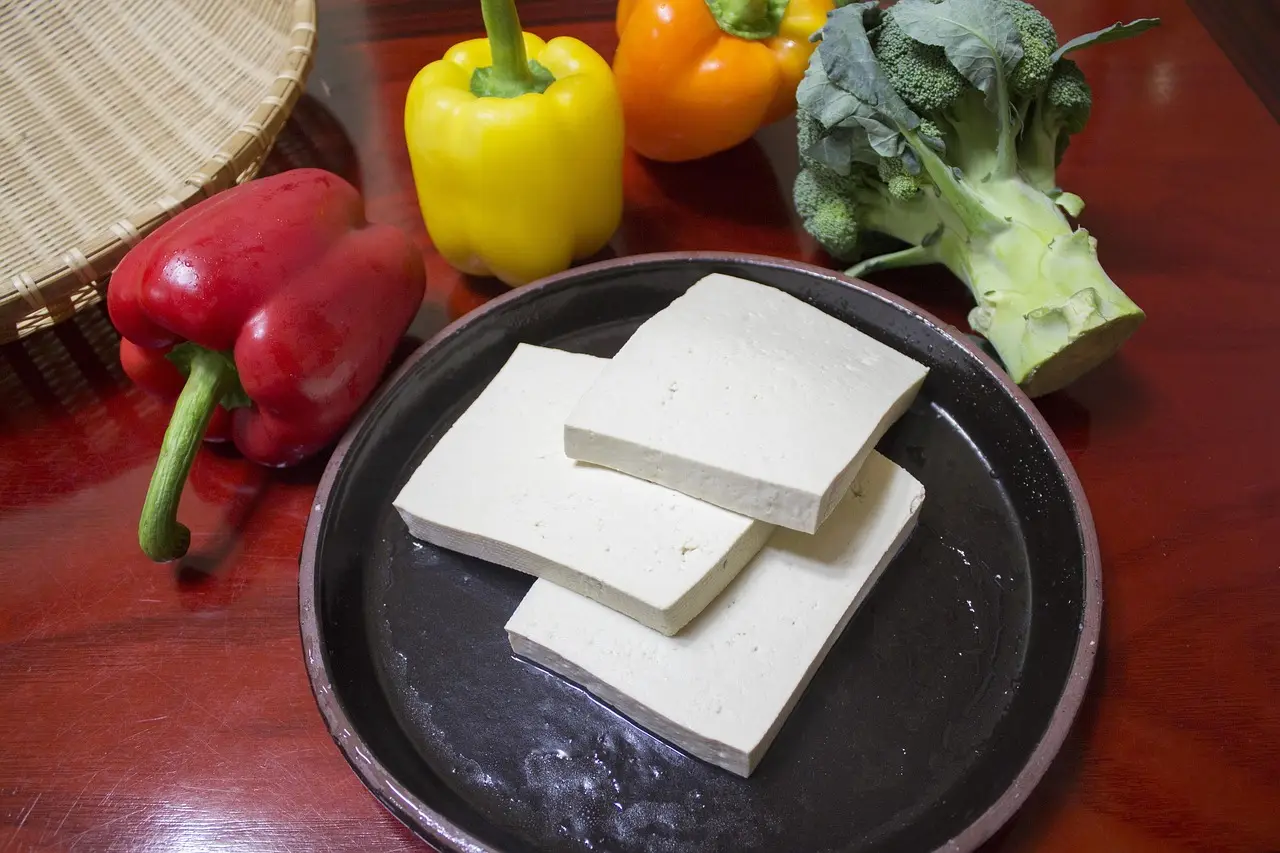
Tofu is soy milk turned into curds and pressed into soft white blocks, much the way cheese is made from dairy milk. It has fed East Asia for more than a thousand years, and it carries a surprising amount of baggage for something so mild: a legendary prince, a 2,000-year-old origin story that probably isn't true, Buddhist monks, and a name that may be a medieval insult. Not bad for a block of bean curd.
Background
Tofu isn't one food but a whole family: silken, firm and pressed, deep-fried pouches and puffs, grilled, smoked, frozen and freeze-dried 1. Soy historians William Shurtleff and Akiko Aoyagi describe it as holding much the same place in East Asian diets that meat, milk and cheese hold in the West 1.
Making it is simple in outline. Soak and grind soybeans, cook and strain the milk, then add a coagulant so it sets 3. In northern and coastal China, cooks traditionally use nigari, the liquid left over from refining sea salt. Inland and in the south, they use gypsum 1. Firm tofu holds its shape in a stir-fry or on the grill; silken tofu is soft enough to blend into a sauce or a dessert 3.
The name is Japanese. In Mandarin it's doufu; in Hokkien, tau-hu 1. English speakers once called it "bean curd", "bean cheese" or "soy cheese". "Tofu" won in the West largely after Shurtleff and Aoyagi's The Book of Tofu came out in 1975 1.
History
Tofu almost certainly began in China, but nobody knows when 1.
The prince. The most famous story credits Liu An, King of Huainan, who lived from 179 to 122 BCE 1. China's great sixteenth-century herbal, the Bencao Gangmu, repeats it, and many sources still do 123. Shurtleff and Aoyagi call it the best known theory and "probably the least likely to be true". The scholarly book Liu An sponsored never mentions tofu, and nobody links his name to it for more than a thousand years after his death 1. One later legend even says he ate tofu, grew younger, sprouted wings and flew to heaven 1. Japan's national tofu association also notes there's no written record of tofu before the Tang dynasty, so the Liu An story can't be confirmed 2.
The other theories. Some suggest a happy accident: a cook seasoned a soybean soup with unrefined sea salt and watched it curdle 1. Others suggest the technique came from India, or from dairying peoples on China's northern frontier who made cheese 1. Shinoda, whom Shurtleff and Aoyagi call Japan's foremost authority on the history of Chinese food, favoured the last idea 1.
The insult. Here's the fun bit. Shinoda argued that when the Chinese wrote down the nomads' word for a cultured milk food, rufu, they used a character for fu that also meant "spoiled", partly out of contempt for the herders. Later, dou (bean) replaced ru (milk), giving doufu: literally "spoiled bean". As Shurtleff and Aoyagi put it, the insult boomeranged 1. It's a theory, not a fact, but it's a good one.
The first record. The oldest known written mention of doufu comes from around 950 CE. It tells of a poor official who couldn't afford mutton, so he ate tofu with his rice every day. Locals nicknamed it "the vice mayor's mutton" 1. By the Ming dynasty, rich and poor alike were eating it 1.
To Japan and beyond. Tofu probably reached Japan with Buddhist monks travelling between the two countries, sometime between about 900 and 1100, though Japan's tofu association notes some accounts put it as early as the Nara period (710–784) 12. Its first Japanese mention is in the diary of a priest at Kasuga Shrine in Nara, who listed it among offerings at the altar in 1182 or 1183 (the date depends on how you convert the old calendar) 12. Tofu spread to Korea around the same period, and Chinese migrants carried it to Southeast Asia: the Malay and Indonesian word tauhu comes straight from southern Chinese dialects 1. In the United States, tofu was made from the early twentieth century, but sales only took off around 1970 3.
Customs, rules and rituals
Tofu's best friend has always been Buddhism. Monks who didn't eat meat relied on it, and in Japan the Zen temples' vegetarian cooking, shōjin ryōri, introduced it to ordinary people. From the late 1200s, the big Kamakura Zen temples ran vegetarian restaurants, and visitors who tasted tofu there learned to make it themselves 1. Even now, Kyoto's Nanzenji and Tenryūji temples are ringed by tofu restaurants serving simmered yudōfu 1.
By the Edo period, tofu belonged to everyone. In 1782 a cookbook called Tofu Hyakuchin, "One Hundred Tofu Delicacies", became such a hit that a sequel came out the next year and another the year after 2. Picture it as the viral recipe book of its day.
Tofu-making had its own little rituals too. Old Japanese tofu makers walked their rounds with a pole across one shoulder, announcing themselves with a small brass horn used only by their trade 1.
Place in human experience
For something so humble, tofu has moved between classes with ease. In Song-dynasty China it was common food for poorer people; in one Yuan-era play, a man whose sake turned to vinegar grumbles that he might as well become a tofu maker, which tells you how low the job ranked 1. A few centuries later, tofu was served to emperors 1.
It's also about home. Chinese cookbook writer Buwei Yang Chao wrote that for most Chinese, tofu and cabbage mean "Home Sweet Home" 1. Poets kept comparing fresh tofu to jade, and one Yuan-dynasty ode called it "this food of jade, which no tradition has handed down", as if even then nobody knew where it came from 1.
Wherever Chinese emigrants and Buddhists travelled, tofu shops popped up first in Chinatowns and temples, and local people then learned the craft 1. That's how a white block of curd became a quiet piece of luggage on centuries of journeys. Next time you slice into one, you're holding a very well-travelled food.
Sources
- William Shurtleff and Akiko Aoyagi, "History of Tofu" (pages 1–3), SoyInfo Center. http://www.soyinfocenter.com/HSS/tofu1.php ; http://www.soyinfocenter.com/HSS/tofu2.php ; http://www.soyinfocenter.com/HSS/tofu3.php
- "豆腐の歴史 (The History of Tofu)", Zentoren (Japan Federation of Tofu Manufacturers' Cooperatives). http://www.zentoren.jp/knowledge/history.html
- Tara McHugh, "How Tofu Is Processed", Food Technology Magazine, Institute of Food Technologists, February 2016. https://www.ift.org/news-and-publications/food-technology-magazine/issues/2016/february/columns/processing-how-tofu-is-processed