Wok Cooking
A wok is a deep, round-bottomed pan, and few pieces of kitchen kit work harder. Its name comes from Cantonese (wohk, 鑊); in Mandarin it is often called…
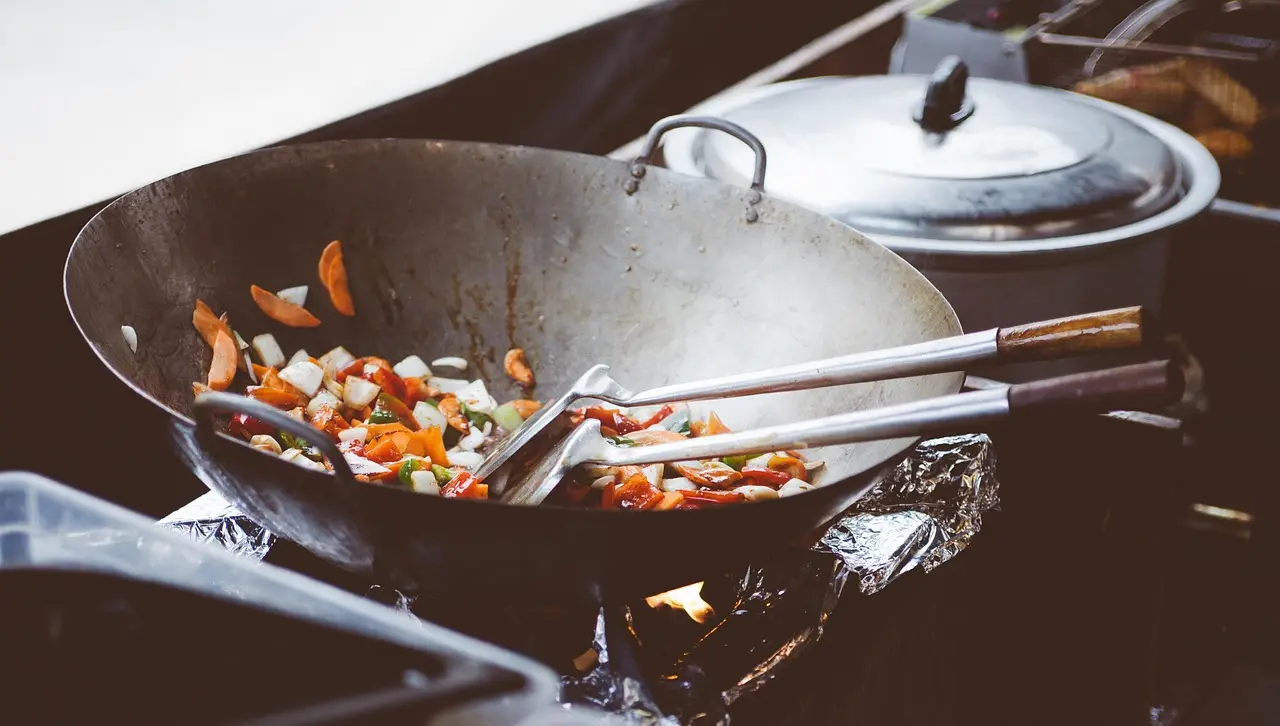
A wok is a deep, round-bottomed pan, and few pieces of kitchen kit work harder. Its name comes from Cantonese (wohk, 鑊); in Mandarin it is often called chǎoguō, the "stir-fry pot" 12. Families across Greater China, and well beyond, use one pan to stir-fry, steam, deep-fry, braise, smoke and boil 1.
Background
The magic sits in the curve. A round bottom lets a spatula or ladle scoop every last scrap off the base and flip it up the sloping sides, and over a gas flame the base of a round wok runs hotter than a flat one 1. Most home woks measure 30 to 36 cm across; restaurant and community-kitchen giants pass a metre and cook rice or soup for crowds 1.
Traditional woks are cast iron or plain carbon steel 3. The finest are still hammered into shape by hand from carbon steel sheets, while cheap ones get stamped from a single sheet by machine and tend to warp and develop hot spots 1. Handles tell you where a wok comes from: two small loops are typical of southern China, while a long stick handle, made for tossing with one arm, is popular in the north, which is why stick-handled woks get nicknamed "Peking pans" 1.
History
Nobody agrees where the wok began, and the arguments are fun. One camp traces it to ancient Chinese round-bottomed cooking pots called fu, at least 3,000 years old. Another argues it came from South or Southeast Asia, a cousin of the Indian karahi and the Malay kuali, travelling into China via Central Asia 1. The earliest possible wok-like pans in China are small clay models on model stoves in Han dynasty tombs (around 202 BCE to 220 CE), but these probably dried grain rather than fried anything. Metal woks used for stir-frying turn up much later, in the Ming dynasty (1368 to 1644) 1.
The wok travelled with the people who cooked in it. One lovely piece of Texas lore says Chinese railroad workers in New Mexico and Texas cooked their lunches in woks in the late 1800s, and local workers, lacking woks, welded shut the holes in old plough discs to copy them. The result, the discada, still feeds outdoor cooks in northern Mexico and the American Southwest 4. Disc-plough cooks are quick to add that farmers worldwide have cooked on old discs for as long as discs have existed, so the railway story is a story, not a proven origin 4.
Customs, rules and rituals
A new wok gets seasoned with oil or pork fat. With use it builds a dark patina of hardened oil that seals the metal and stops food sticking 3. Grace Young, the American food writer known as the "wok therapist", calls that patina a natural non-stick coating 5.
Then come the commandments of the stove. Heat the wok until it just starts to smoke, and only then add cold oil. Never crowd it, or the temperature drops and your stir-fry turns into a steam bath 3. Professional chefs toss rather than stir, 6. At The Chairman in Hong Kong, young chefs practise on staff meals for more than a year before cooking a stir-fry for a paying guest. Co-founder Danny Yip jokes that the heavy pan and wild flames explain why no Chinese chef has any arm hair left 6.
The prize for all that effort is wok hei, the "breath of the wok": the smoky, seared aroma a stir-fry carries for a minute or two after it leaves the fire 36. It comes from caramelising sugars, Maillard browning and oil smoking at heat far beyond typical Western cooking 3. Older Cantonese diners judge a restaurant by it, muttering gau wok hei (enough) or ng gau wok hei (not enough) over their fried rice and beef noodles 6. Other Chinese regional cuisines use woks too, but wok hei as an ideal belongs to the Cantonese south 6.
Place in human experience
For a lot of families the wok is the kitchen. Grace Young points out that many Americans call it a "stir-fry pan", missing that it steams, poaches, braises and smokes, and she uses hers for scrambled eggs, steak and even popcorn 5. Young realised many Chinese Americans of her generation had never learned to use one, so she wrote two books to keep the skill alive; her phrase "breath of a wok" is now standard English kitchen vocabulary 57. Her family's own wok, from around 1949, now sits in the Smithsonian's National Museum of American History as a piece of Chinese American food history 7.
The wok also carries memory and class. Hong Kong's open-air dai pai dong street stalls once numbered in the hundreds; new rules have cut them to about 20, and very few still cook over roaring kerosene flames 8. In 2024 photographer Alex Lau took his mother, Pamela, back to Hong Kong to taste the wok hei she remembered from cheap dinners after long factory shifts in Kowloon. They found it at Oi Man Sang in Sham Shui Po, open since 1956, where a cook works a tyre-sized wok in the middle of the street. Pamela, usually a talker, ate in silence 8.
Sources
- "Wok". Wikipedia. https://en.wikipedia.org/wiki/Wok
- "woks". Art & Architecture Thesaurus, Getty Research Institute. https://vocab.getty.edu/page/aat/300198560
- "What is...wok hei?". The MICHELIN Guide. https://guide.michelin.com/en/article/dining-out/what-is-wok-hei
- Noelle Carter, "Looks like a wok, but it's actually a converted plow disc. Meet the discada". Los Angeles Times. https://www.latimes.com/food/dailydish/la-fo-co-fire-disc-outdoor-cooking-recipes-20180901-story.html
- "Meet Grace Young, the wok guru fighting to save America's Chinatowns". CNN Travel. https://www.cnn.com/travel/article/grace-young-julia-child-award-winner/index.html
- "Wok hei: The science behind 'the breath of a wok'". CNN Travel. https://www.cnn.com/travel/article/wok-hei-perfect-fried-rice-hong-kong/index.html
- "Grace Young – The Stir-Fry Guru" (homepage biography). Grace Young. https://www.graceyoung.com/
- Alex Lau, "Wok Hei Is Vanishing From Hong Kong. My Mom Wanted to Taste It Again". The New York Times Magazine. https://www.nytimes.com/interactive/2024/09/26/magazine/hong-kong-dai-pai-dong.html