Knife Skills for Home Cooks
Basic knife skills for home cooks: choosing a knife, the pinch grip and claw, the main cuts, sharpening, and how to cut safely without slowing down.

Good knife skills make cooking faster, safer and more fun. An onion takes one minute instead of five, and food cooks evenly when the pieces match. You need one decent knife, a steady board, two hand positions and some practice.
Choose one good knife
Most home cooking needs just one knife: a cook's or chef's knife, usually around 20 cm long. CHOICE, which tests kitchen knives, says to look for a comfortable non-slip handle, good balance and a gently curved blade 1. Feel matters more than price: in CHOICE's testing, expensive forged knives weren't automatically better than cheaper stamped ones, and some budget chef's knives performed well 1.
Worth adding: a paring knife for small jobs and a serrated bread knife 1.
Set up your board
- Use wood or plastic. A board softer than the blade protects the edge 1, so skip glass, marble and stone.
- Stop it sliding. Put a damp tea towel under the board.
- Use two boards. One for raw meat, poultry and seafood, another for anything that won't be cooked, like salad and bread 2. Wash both in hot soapy water after use 2.
How to hold the knife: the pinch grip
Most beginners grip the handle like a hammer. Instead, "pinch" the blade. Grip the handle with your bottom three fingers and pinch the blade just in front of the handle between your thumb and bent index finger. Cookery writer Maggie Beer describes a good knife this way: "it truly becomes an extension of your arm rather than just a kitchen tool" 1.
How to hold the food: the claw
Your other hand is the one at risk. Curl your fingertips under like a claw, knuckles forward. The flat of the blade slides against your knuckles while your fingertips stay tucked behind. Walk the claw back as you cut.
Never cut towards food held in your palm.
The basic motions
- Rock chop. Tip on the board, rock the heel up and down. For herbs and garlic.
- Push cut. Push the knife forward and down through the food in one smooth stroke. Best for vegetables like carrots, onions and capsicum.
- Slice. A long, gentle draw back through the food. Use it for meat, tomatoes and bread, and let the blade do the work instead of pressing down.
The cuts you'll use most
| Cut | Size | Good for | |---|---|---| | Rough chop | Uneven, bite-sized | Soups, stews, roasting | | Dice | Even cubes: large 2 cm, medium 1.5 cm, small 5 mm | Sauces, curries, salads | | Mince | Very fine | Garlic, ginger, chilli | | Julienne | Thin matchsticks | Stir-fries, spring rolls, banh mi pickles | | Chiffonade | Fine ribbons | Basil, spinach, mint |
The secret to every one of them: make a flat side first. Cut a thin slice off a round vegetable so it sits flat on the board and can't roll. Then you can cut planks, then sticks, then cubes, in that order.
How to dice an onion
- Cut the onion in half from root to tip, through the root. Peel it, leaving the root on; it holds the layers together.
- Lay one half flat. Make thin vertical cuts towards the root, stopping just short of it.
- Make one or two horizontal cuts towards the root, holding the top with a flat palm.
- Now cut across. Perfect dice fall away. Throw out the root end.
For more on vegetables, see our chopping vegetables guide.
A warning about avocados
Avocado knife injuries have their own research. A 2020 study in the American Journal of Emergency Medicine estimated more than 50,000 avocado-related knife injuries treated in US emergency departments between 1998 and 2017, rising sharply as avocados became more popular 3. Most were to the non-dominant hand, the one holding the fruit 3.
The safe way: put the avocado on the board, not in your palm. Cut lengthwise around the stone, twist the halves apart, then scoop the stone out with a spoon. Don't stab it with the knife.
Keep it sharp
A sharp knife is safer: a blunt one needs more force and can skid off a tomato skin into your finger.
- Hone often. A honing steel straightens the edge between sharpenings 1.
- Sharpen sometimes. Use a whetstone or pull-through sharpener, or take your knife to a cookware shop that offers professional sharpening 1.
- Wash by hand. Dishwasher detergents can be too harsh, and some foods are acidic enough to stain the blade, so wash and dry it soon after use 1.
- Store it safely. Use a knife block, magnetic strip or blade guard so it isn't knocking around a drawer 1.
Safety rules worth repeating
Practise with real dinners
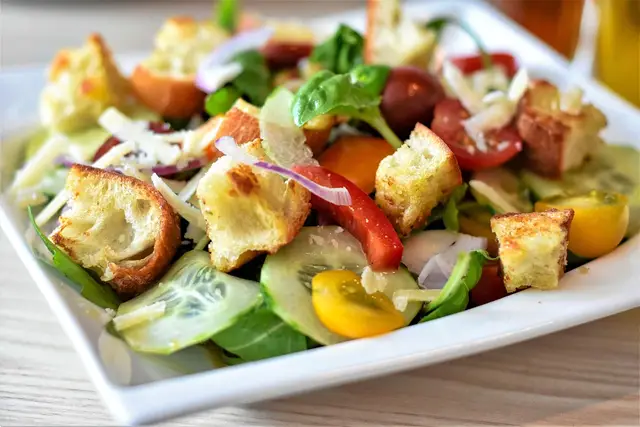
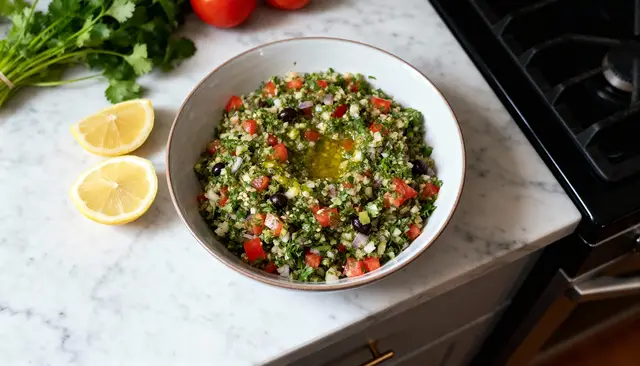
A Greek salad, a stir-fry, a herby tabbouleh or winter vegetable soup all give plenty of practice. Go slowly; speed comes on its own. For raw meat and leftovers, see our food safety guide.
Sources
- Ciaramidaro, R. and Zaluzny, P., "How to buy the best kitchen knife", CHOICE, updated 23 July 2024. https://www.choice.com.au/home-and-living/kitchen/knives/buying-guides/kitchen-knives
- Food Standards Australia New Zealand, "Food safety basics". https://www.foodstandards.gov.au/consumer/prevention-of-foodborne-illness/food-safety-basics
- Farley, K. X. et al., "Avocado-related knife injuries: describing an epidemic of hand injury", American Journal of Emergency Medicine 38(5), 864–868, 2020. https://doi.org/10.1016/j.ajem.2019.06.051
- NSW Food Authority, "Keeping food safe". https://www.foodauthority.nsw.gov.au/consumer/keeping-food-safe